
This post reflects our initial review of the 2026 City of Toronto budget, released January 8, 2026. Detailed City Budget Notes and initial Briefing Notes were released late in the afternoon and Social Planning Toronto staff will dig into individual budgets and provide a deeper analysis in the days to come.
On January 8, the staff-prepared 2026 City of Toronto Budget was launched. Despite significant budget challenges, this year’s budget includes targeted new investments totalling $28.4 million to expand some key public and community services. The budget also safeguards existing services, including significant new investments made in recent years, and prioritizes issues of affordability. However, the need for greater investment to respond to multiple community crises far outstrips available resources.
A presentation by senior city staff highlighted investments in new and enhanced services. These included:
-
expansion of food programs to 155 new school communities supporting approximately 62,000 students and 96 new camp nutrition locations with snacks for approximately 60,000 campers;
-
TTC fare capping providing 2.1 million net new free rides; in addition, the budget includes a third year of fare freezes and expansion to transit service;
Under the TTC’s fare capping program, adult, youth, and senior riders will pay for a maximum of 47 rides in a calendar month, after which additional trips are free for the rest of the month. Riders using Presto, debit or credit have access to the fare capping program. The program starts on September 1, 2026. The TTC plans to improve the program, reducing the cap to 40 rides per month beginning on September 1, 2027 (requires 2027 budget approval).
-
expansion of Social and Crisis Support Service to 4 more libraries;
Toronto Public Library Budget Notes describe the service: “Crisis Workers provide short-term counseling, mental health supports, referrals for health and housing supports, wellness checks and other crisis interventions as well as specialized programming to address proactive mental health planning and coping strategies.”
-
roll-out of colour-coded RentSafeTO ratings to 3,600 buildings;
According to the Municipal Licensing and Standards Budget Notes: “The RentSafeTO program seeks to positively impact lower-income and vulnerable individuals and families by ensuring apartment building owners comply with building maintenance standards, thereby improving living conditions within apartment buildings.” The budget supports the implementation of a colour-coded rating system which will sort “apartment buildings into categories based on their compliance with City bylaws and other applicable law and providing each apartment building a colour coded rating which the owner or operator must post in the apartment building.”
-
enhanced crisis services on the transit system;
According to the Social Development Budget Notes: Funding will support service coordination, “allowing [Toronto Community Crisis Service] TCCS crisis workers on TTC to respond to incidents of people experiencing a mental health crisis with a trauma-informed, harm-reduction, and consent-based service model” and evaluation of the pilot outcomes.
-
expansion of Toronto Public Library’s Open Hours Plan to 17 more libraries, with all 100 branches to be open 7 days per week by the Summer of 2026;
-
1,000+ AC units for low income vulnerable residents; this addition builds on the City’s successful pilot project in 2025;
-
new Green Infrastructure Incentives and Rain Barrel Programs;
- 27 additional Traffic Agents to improve intersections and travel times;
New and enhanced funding also covers 258 new emergency positions supporting response times. This may include 143 net new police officers, as reflected in the Toronto Police Service budget.
On December 10, the Toronto Police Service Board approved a $1.7043 billion budget (from all revenue sources), including $1.4329 billion supported by property taxes. If approved by City Council, this will result in a 7%, or $93.8 million, increase in the net budget (from property taxes), over the 2025 net police budget.
Senior city staff also noted that there is $2 million in funds that have not yet been allocated to specific programs or services. The Mayor may choose to allocate those funds in her budget, or leave the decision with City Council.
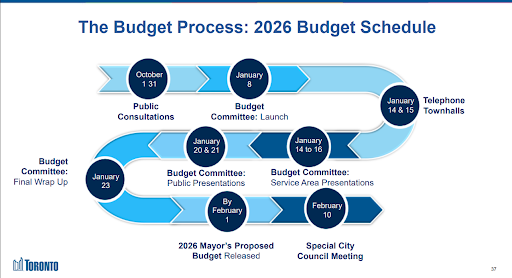
The staff-prepared budget is a draft budget. All budget decisions rest with the Mayor and Council, with final budget votes taking place on February 10. Community advocacy is critical to the final budget. We share opportunities for participation in the budget process below.
Revenue Challenges
The City of Toronto has had a long-standing revenue problem with inadequate funding and insufficient revenue tools to support critical programs and services and vital infrastructure essential to creating a livable, equitable and sustainable city for all Toronto residents. Municipal revenue problems are driven by limited powers to implement new and effective revenue tools and a lack of long-term sustainable funding arrangements with the federal and provincial governments—while the 3-year “New Deal” between the Ontario government and City of Toronto has been an important step forward.
This year’s budget is especially challenging with limited or reduced revenues due to:
- a decline in TTC ridership
- significantly reduced funding from the Municipal Land Transfer Tax due to 25-year record low real estate sales
- a lack of revenue tools available to municipalities where funds grow with the economy, such as income tax or a share of the provincial sales tax
- provincial changes to development charges (DCs). According to the Chief Financial Officer, the City estimates an annual loss of $50-$70 million in revenue for the City of Toronto due to the province’s elimination of the use of Section 37 funds and shift to DCs. Further, the province has shifted DC payment schedules from the building permit stage to the occupancy stage which will delay the city receiving revenue from DCs by 3-4 years.
Property Taxes
The budget proposes a 2.2% tax increase for residential properties, including a 0.7% property tax increase and a 1.5% increase to the City Building Fund for affordable housing and transit infrastructure. For the average residential home valued at $692,140, the increase is $91.53 for 2026, or $7.63 per month, with a total bill of $4,252, excluding provincial education property taxes.
To address some affordability issues, the City of Toronto offers property tax, water, and solid waste relief programs for low- and modest-income homeowners who are seniors and people with disabilities.
The “Mansion Tax”
In 2025, Mayor Chow with the support of City Council took steps to increase revenues by raising Municipal Land Transfer Tax rates on luxury homes priced at more than $3 million. In 2026, the City anticipates receiving a total of $152 million from the MLTT on luxury home purchases, including $13.8 million from the rate increase. Recognizing deep social inequities within our city and the need for additional revenues for critical services, Social Planning Toronto advocated with community partner organizations for a luxury homes tax for many years.
Have Your Say!
The City Budget process continues over the next few weeks, concluding with City Council’s final votes on February 10.
- Sign up to participate in a Telephone Townhall with the Mayor and Budget Chair, taking place on January 14 and 15.
- Share your thoughts, ideas, and concerns about the budget with members of the Budget Committee at public hearings/ deputations on January 20 or 21. Find details and register here.
Resources
- City of Toronto’s 2026 Budget Presentation
- City of Toronto’s 2026 Budget page
- Social Planning Toronto’s 2026 City Budget Resources
- Sign Up for SPT’s City Budget Watch newsletter
SPT’s Budget Events
Watch a recording of SPT’s Budget 101 session
Upcoming Budget Events Hosted by SPT:
Deputations 101
This workshop will explore how you can make your voice heard at Budget Committee Public Presentation meetings.
January 14, 7:00 - 9 p.m.
Housing Advocacy Workshop
Our Housing Advocacy Workshop, in collaboration with community partners, will support you in understanding key municipal housing and tenant programs, policies, and advocacy initiatives.
January 16, 10:00 a.m. - 12 p.m.
Budget Town Hall
SPT's Senior Researcher and other experts will provide a community perspective on the City’s newly released budget.
January 19, 2:00 p.m. - 4 p.m.
Register at www.socialplanningtoronto.org/events
SPT will share more analysis of the 2026 City budget in the days and weeks to come. Sign up for SPT’s City Budget Watch newsletter for updates.