
It comes as no surprise that the Toronto Police Service (TPS) budget includes another significant increase, despite the City identifying 2026 as a tough budget year. This year’s budget proposes a $93.8 million increase from the property tax base, amounting to a total net budget of $1.43 billion. This increase is largely driven by salary increases in the collective bargaining agreements ($50.7 million) and the hiring of 143 net new officers ($20.5 million). The latter has been framed by the TPS as a community safety measure.
Tell that to Indigenous, Black and other racialized community members who are lining up to join a class action lawsuit to challenge TPS’s “carding” policy and related ongoing practices as violations of their human rights under the Canadian Charter of Rights and Freedoms and the Ontario Human Rights Code. It’s also unlikely to be embraced by the 43% of Toronto residents who participated in city budget consultations, naming police services as their top service for budget cuts. Many residents and groups have called for Toronto City Council to redirect police funding to proactive investment in community services that support community safety, addressing the root causes of violence. In addition, this year’s police budget fails to make headway on the Toronto Auditor General’s cost-saving recommendations to develop alternatives to policing for the delivery of some key services—outlined in a 2022 Auditor General’s report more than 3.5 years ago.
A Deep Dive into the TPS Budget
The budget hasn’t been finalized yet. The Mayor’s Budget will be released by February 1, with final votes by City Council on February 10. If approved, TPS’s operating budget would rise to $1.70 billion (gross, i.e. from all revenue sources), including $1.43 billion (net) from property taxes, in 2026. Under the staff-prepared budget, nearly one out of every five dollars from property taxes will go to the TPS—18.6% of property taxes go to police; second only to TTC at 19.1%. Meanwhile other critical services—many essential to community safety and violence prevention—have a history of chronic underfunding, despite recent efforts to bring more investment to these critical areas.
To understand the scale of the TPS budget request, consider that the portion of Toronto's tax base allocated to policing is roughly equivalent to the combined tax funding for:
- Parks & Recreation;
- Toronto Shelter and Support Services;
- Children's Services;
- Seniors Services and Long-Term Care;
- Social Development, Finance & Administration;
- Toronto Public Health;
- Toronto Public Library;
- Toronto Zoo; and
- Municipal Licensing & Standards.
In 2018, TPS made a total budget request of just under $1 billion. Since then, the police have seen a steady increase in their budget.
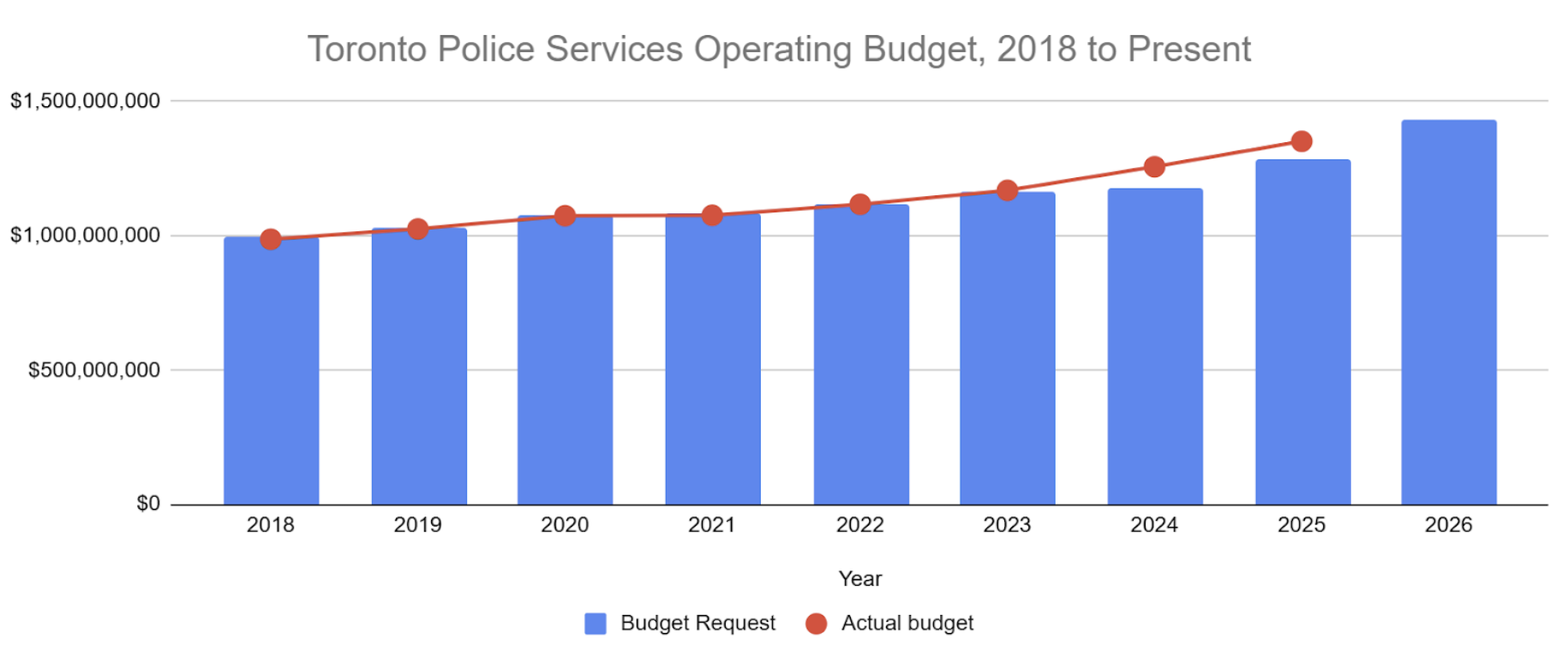
Note: 2025 Projected Actual
Sources: City of Toronto. (2018-2025). Toronto Police Service Budget Note. Retrieved from https://www.toronto.ca/city-government/budget-finances/city-budget/previous-budgets/
City of Toronto. (2026). 2026 Budget Notes Toronto Police Service. Retrieved from https://www.toronto.ca/legdocs/mmis/2026/bu/bgrd/backgroundfile-261506.pdf
This year’s proposed $93.8 million increase from property taxes is largely driven by salary increases in the collective bargaining agreements ($50.7 million) and 143 net new officers ($20.5 million). Additional contributors to the budget increase include other salary requirements, statutory deductions and benefits, and other expenditures.
The TPS provides several reasons why such a large increase is necessary. Staffing-related costs make up 90% of the police’s operating budget. In the lead up to the 2025 budget, the TPS Board approved a multi-year hiring plan that focused on maintaining the cop-to-pop ratio of 172 officers per 100,000 residents. This plan set out a target of 143 net new officers in 2026 and will see 220 new officers hired in 2027-2029. The TPS argues that this staffing level is necessary to maintain capacity and bring down response times. The new officers will be allocated as follows:
- 70 positions dedicated to priority response to meet increased demand and further improve response times;
- 40 positions dedicated to increase investigative capacity;
- 17 positions dedicated to recruitment, training and onboarding of new officers and additional annual training requirements for modernization;
- 16 positions to support ongoing Neighbourhood Community Officer program expansion in up to four additional neighbourhoods in 2026.
As mentioned, the multi-year hiring plan is grounded in maintaining the cop-to-pop ratio. While this metric is a common measurement of service capacity, relying too heavily on it can be misleading because it oversimplifies how policing actually works. It assumes that having more officers automatically makes a city safer, without accounting for how officers are used and what they’re responding to. The metric ignores real demand, like call volume, call complexity, commuting populations, and local conditions. Focusing on this single number can also shut down more useful conversations about efficiency, alternative responses, and better ways to deliver public safety.
It also doesn’t address the fact that a higher police presence does not signal greater safety for all, particularly Black, Indigenous, and racialized individuals who have been subject to discrimination in policing, for example as identified in the recent carding class action lawsuit.
In 2022, the Toronto Auditor General examined whether the Toronto Police Services is using resources efficiently and effectively to achieve its mandate. The main conclusion presented in the Auditor’s report was that the TPS is defaulted to for some matters that do not require a police response, in part due to lack of alternative resources. The Auditor found that, if proper alternative responses were available, 40% of calls for service in six lower priority event types could have been handled by alternative responses and that 85,000 hours over 5 years could be saved. These data point to the potential and importance of community safety initiatives.
The Toronto Community Crisis Service (TCCS) is a prime example of the power of non-police, community-based responses and is now recognized as Toronto’s fourth emergency service. From its inception in March 2022 to December 2024, TCCS received 10,339 mental health crisis calls and wellness checks, 7,800 of which were diverted from 9-1-1. 78% of total calls were completed without police involvement. Projections for 2025 put the overall diversion rate at 84%. But there are opportunities to extend non-police responses beyond mental health. The Auditor General’s report identified 6 event types—check address, check well-being, dispute, noisy parties, landlord & tenant dispute, and unwanted guest—that could potentially be handled by a non-police responder. Exploring opportunities to redirect some police calls to new or existing civilian services would not only save taxpayers money, it is exactly what communities have been asking for.
The community has made calls over and over again for the City of Toronto to divert funds away from the police. For the past two years community consultations that engaged diverse, racialized, and low-income individuals identified the police services as the top category for decreased investment. Residents raised questions around police productivity and discrimination, made suggestions for alternatives for crime prevention, and called for investment in youth prevention. Importantly, residents expressed a desire to address the root causes of crime and safety. Prioritizing affordable housing, youth programs, mental health supports, and community safety initiatives can ensure there are fewer crises to begin with.
While the Toronto Police Service’s budget request document lists how residents can provide feedback and states that “the allocation of [their] resources and budget reflects priorities informed through this feedback” (p.28), it fails to go further. No information is provided on what residents said or the specific changes that were made in response. This lack of transparency raises questions about whether community input meaningfully influences police budgeting.
This year the Police Service Board changed its process for receiving public deputations on the police budget. Instead of appearing before the full seven-member board, residents were limited to deputing before a three-member budget subcommittee—unlike the Toronto Board of Health, where residents have an opportunity to speak about the Toronto Public Health budget with the full membership of the board. The Board justified the change on the basis that it would allow people with day jobs to depute as the committee meeting would be in the evening and that Board members not present at the meeting could still listen to the recordings of the deputations. But public deputations are one of the few formal avenues residents have to influence police governance. Limiting them to a subset of the Board represents a weakening of oversight, especially for a budget of this scale.
Toronto is facing significant budget pressures and a large increase to the police budget will, inevitably, affect what the City can invest in other community services. The Police Budget will now move through the City’s budget process where City Councillors can review it, request more information about it, and suggest amendments. The Mayor will present the final budget by February 1st, with Council voting on February 10th to any amendments to the Mayor’s budget.
Whether the police budget increase is justified ultimately depends on how Toronto defines safety, and whether the City chooses to invest primarily in policing and enforcement approaches or in the community supports that prevent and reduce the need for police in the first place.