The following newsletter was distributed to our subscribers on July 22, 2025 with the headline "Homelessness is Skyrocketing in Toronto. Here’s What You Can Do About It." Sign up for our newsletter here.
Last week, the City of Toronto released the Street Needs Assessment, a survey of people experiencing homelessness across the City. The latest report used data from October 2024. The numbers are troubling: 15,418 people in Toronto are experiencing homelessness, with 1,615 of those sleeping outdoors. This is a stark increase from the 2018 report, which found that 8,715 people in Toronto were experiencing homelessness. (In 2021, that number decreased to 7,347, though those numbers were impacted by the COVID-19 emergency response). Shelters are full, and according to the City’s numbers, over a hundred people every night continue to be turned away by Central Intake.
The report was considered on July 9 by the City’s Economic and Community Development Committee (ECDC) meeting along with the adoption of a motion to advance the City’s shelter infrastructure to open 20 new permanent shelters across Toronto by 2033. These purpose-built shelters will be spread throughout the City and will be smaller than many existing shelters (with capacities ranging from 50-80 beds each). Plans for the first six of these shelters are underway. On July 15, the City’s Planning and Housing Committee (PHC) approved zoning amendments for all six sites, and the item will be considered at this week's City Council meeting. SPT staff deputed in favour of the shelters at both the ECDC and the PHC meetings.
Despite both these items advancing at their respective meetings, there has been intense organized backlash to several of the proposed shelter sites from both Councillors and members of the public. Canada recognizes the human right to adequate housing. The recent SNA report shows that all levels of government have a long way to go before this basic right is met for all residents. Building new shelters alone will not be enough to solve the housing affordability crisis, but it is an important and vital step that the City can take to mitigate some of the harms of the housing crisis and poor policy decisions, while continuing to pursue other, long-term options.
There will be some time before all planned 20 shelters are open and operational, which means there will likely be more attempts from opponents to block them. Progress Toronto has created an email template you can use to contact your City Councillor, MPP, MP, and the Mayor to support the City’s shelter infrastructure plan ahead of tomorrow's Council meeting. SPT also encourages residents across the City to talk to your friends and neighbours about the need for shelter beds. Community groups including Etobicoke Lakeshore Shelter Support Coalition, Willowdale in Neighbourly Community, and West End Welcomes have resources and information about specific shelters.
In this issue:
- Take Action: Tell the Province to Support Toronto’s Universal School Food Program
- Free Event: Scarborough Youth Safety Dialogue
- Take Action: Support Faster Public Transit on Dufferin and Bathurst
- Community Funding Opportunity Available Ahead of 2026 World Cup
- Welcoming Our 2025 Civic Leaders!
- New Report Sheds Light on Canada’s Nonprofit Workforce
- Land Use Planning Training Series Open to Nonprofit Workers and Resident Leaders
Take Action: Tell the Province to Support Toronto’s Universal School Food Program
Last month, Toronto City Council moved forward with their plan to adopt a universal school food program. This is a welcome development. Social Planning Toronto’s Child and Family Poverty Report, released last year, found that child poverty in Toronto has ballooned to 25.3%, up 8.5 percentage points since 2020, with the rate being as high as 60% in some Toronto neighbourhoods. SPT’s Director of Engagement and Strategic Initiatives deputed in favour of the program at last month’s Executive Committee meeting, and also encouraged Council to see this not as a one-off program but as part of a larger conversation to make sure Toronto has an actionable, effective, and measurable poverty reduction strategy.
In order to successfully fund a universal school food program, the provincial government must match the City’s investment. (Unlike other provinces, Ontario has not increased its investment in school meals since 2015.) Progress Toronto has created an e-mail template that you can use to contact Premier Ford and your MPP.
Free Event: Scarborough Youth Safety Dialogue
The Scarborough Civic Action Network will be hosting a Youth Safety Dialogue on Wednesday, July 23 at 6pm at the Dorset Park Community Hub. This event is part of SCAN’s ongoing commitment to creating safer, more supportive spaces for Scarborough’s youth. The evening will feature guest speakers from community organizations who will lead a conversation around youth safety, the barriers that young people face, and the various ways we can all work together to support, empower, and protect them. Refreshments will be provided. Registration is encouraged.
Take Action: Support Faster Public Transit on Dufferin and Bathurst
City Council will soon be voting on a motion to create transit-only lanes on Dufferin and Bathurst Streets. This RapidTO program will get buses and streetcars out of rush hour traffic and lead to faster trips, more reliable transit, and less pollution and congestion on city streets. If you are one of the 75,000 daily commuters who use these routes, you’ll understand that dedicated bus and streetcar lanes are long overdue. Toronto’s Executive Committee heard six hours worth of deputations from speakers, most of whom were in favour of RapidTO.
The current proposed lanes are significantly shorter than those in the initial proposal, and will only run south of Bloor Street. The Executive Committee approved an amendment to support the development of implementation plans to extend the lanes north of Bloor, and to report back. Now is the time to make your voice heard. TTCRiders has created an e-mail template you can use to let your Councillor know you support dedicated transit lanes.
Community Funding Opportunity Available Ahead of 2026 World Cup
Toronto will be one of 16 host cities for the FIFA World Cup 26 taking place from June 11 to July 19, 2026. Toronto’s theme for the tournament is “World in a City.” The City of Toronto is providing funding for community-driven cultural projects and event that celebrate this theme. Eligible events will demonstrate community engagement and offer programming, activities, or events that are free, open, and accessible to the public. Grants are available for up to 50 percent of eligible expenses maximum amount of $40,000. Applications are open until September 17. Learn more about how to apply.
Volunteer opportunities are also available for the FIFA World Cup. Learn more.
Welcoming Our 2025 Civic Leaders!
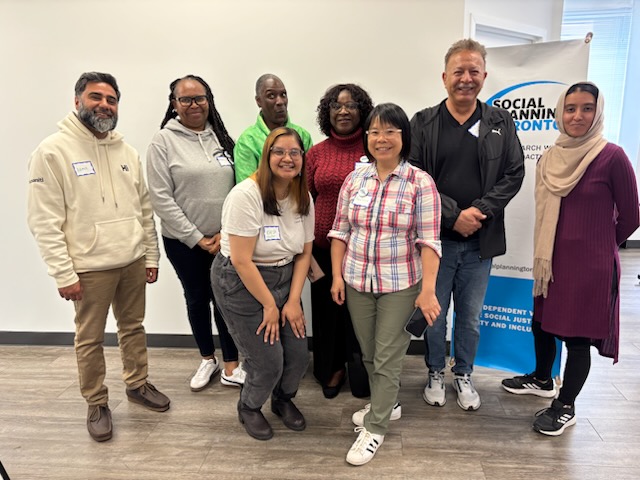
Social Planning Toronto is pleased to welcome our 2025 Civic Leaders cohort. This program is designed to support resident leadership and network building at the neighbourhood level, which will in turn inform how SPT engages with community leaders representing neighbourhoods across the city. The Civic Leaders will meet virtually throughout the year and engage in structured organizing activities focused on a key issue to be determined by each leader. Welcome Leya C, Courage Bacchus, Aamir Sukhera, Phina Asika. Melissa Lai, Marcia Farrell, Raisa Kabir, and Gabriel Ermatinger, pictured above at May’s orientation meeting.
New Report Sheds Light on Canada’s Nonprofit Workforce
Imagine Canada has published People First: A Portrait of Canada’s Nonprofit Workforce. The report uses recently updated data from Statistics Canada to provide key insights into the nonprofit workforce: nonprofits employ 2.5 million people, making the sector the largest employer in Canada. Compared to other workers, nonprofit employees are more likely to be women, to have higher levels of formal education, and are paid significantly less than workers in the for-profit and government sectors. Average salaries for racialized nonprofit workers are about 12% lower than non-racialized nonprofit workers. Read the full report.
Land Use Planning Training Series Open to Nonprofit Workers and Resident Leaders
From the Ground Up is a training series developed by CP Planning in partnership with United Way Greater Toronto to support community-based organizations and resident leaders in pushing for equitable development across the region. Nonprofit organizations with established roots in their communities are working to preserve affordable housing, protect community spaces, and sustain culturally meaningful local businesses, yet they are often excluded from the planning processes that shape their neighbourhoods.
From the Ground Up will run every two weeks from September to December 2025. Registration is open until July 30. Learn more.