
It’s been busy at the SPT offices as we prepare for Toronto’s City Budget season. Through the budget process, Toronto City Council makes important decisions about critical programs, services, and infrastructure — what it’s going to fund (adequately or not), if it’s going to cut programs or services, if it’s going to freeze budgets (given rising program costs, a budget freeze is, in effect, a service cut), and how it’s going to pay for these vital programs.
The budget is informed by public feedback, in the form of community consultations, committee deputations, and campaigns organized by grassroots groups. Social Planning Toronto has compiled a list of resources, including breakdowns on how the budget process works, lists of key dates, information about upcoming events, and more. Those unfamiliar with the budget process may find our downloadable Budget Explainer (developed in partnership with Albion Neighbourhood Services) and our City Budget Primer workshop from 2023 especially helpful.
City Council won’t consider the 2026 budget until early next year, but the City is hosting virtual and in-person public consultations throughout the month of October. Toronto residents are also invited to share their budget priorities via an online survey, open until October 31.
The best way to stay informed on all things city budget is by signing up for our City Budget Watch newsletter. We’ll send up-to-date analysis, details on how to get involved, and information about upcoming events and workshops. The CBW newsletter will go out sporadically between now and the end of the year, and about once or twice a week between January 8 (when the staff recommended budget launches) and February 10 (when City Council considers and passes the budget).
In this issue:
- Responding to Toronto’s Growing Homelessness Crisis
- Inclusionary Zoning Bylaw Finally Takes Effect After Years of Provincial Delay
- How to Meet With Your MP To Support Rights for Refugees and Fight Poverty
- Event: National Dialogue on a Future Without Poverty 2025
- Event: Rally to Oppose Bill 33
- Event: Raise the Rates Rally Demands Rent Freeze, Increased Wages
- TTCRiders Launches a New Campaign Urging Toronto to Consider Farecapping
- Maytree Policy School Seeking Applications for 2026
- New Report Examines Hidden Part of Ontario’s Social Assistance System
- Survey: Disability Without Poverty Seeking Feedback on Monthly Expenses
Responding to Toronto’s Growing Homelessness Crisis
As the City of Toronto moves forward with their plan to open 20 purpose-built shelters by 2033, some residents have been expressing anxiety and other concerns about the presence of shelters in their neighbourhoods. These feelings are often rooted in misinformation.
SPT has partnered with community activist Diana Chan Mcnally to develop Talking About Homelessness, a messaging guide for organizations, communities, and individuals.
This guide can be applied to help you to develop presentations, workshops, media, social media, and stakeholder communications. It can also be used one-on-one, and in developing internal communications to combat misconceptions around homelessness among staff and volunteers. The guide includes some first steps for organizing your own local group in support of shelters.
This month, the Etobicoke-Lakeshore Shelter Support Coalition will be hosting Unhoused People are Our Neighbours Too: A community learning series. This free, in-person series invites curious neighbours to learn together about issues of homelessness and housing from seasoned experts. Upcoming workshop topics include the basics of harm reduction (October 16, 5:30 - 7:30 p.m.) and supporting people on the streets (October 22, 5:30 - 7:30 p.m.). Both workshops will be at LAMP Community Health Centre (185 Fifth St.). Light dinner and snacks will be provided.
The proposed shelters are badly needed as Toronto’s homelessness crisis grows. The City is facing a $107 million shortfall since the Federal Government announced they would only provide a quarter of the funding that Toronto requires to shelter refugees and asylum shelters.
On September 29, Toronto’s Executive Committee approved a motion to request that the Federal Government supports the housing costs for refugee claimants and asylum seekers, and that the Provincial and Federal governments increase Toronto’s allocation for rent supplements through the Canada-Ontario Housing Benefit. Social Planning Toronto joined other community organizations in deputing in favour of this motion. Read our full submission.
Progress Toronto has created a letter template you can use to contact Prime Minister Mark Carney and your local MP urging them to reverse Canada’s decision to cut Toronto’s funding for refugee shelters.
Inclusionary Zoning Bylaw Finally Takes Effect After Years of Provincial Delay
In November of 2021, Toronto City Council voted to pass an inclusionary zoning (IZ) bylaw. IZ is a tool for the creation of affordable housing: new residential developments that meet specific criteria are required to include a portion of affordable ownership or rental housing as part of the development. These affordable housing requirements were set to take effect on September 18, 2022, pending provincial approval.
Yet the Ontario Ministry of Municipal Affairs and Housing only approved IZ areas in Toronto on August 15, 2025, nearly three years later without a single unit of affordable housing built under IZ.
On our blog, we have a detailed analysis of how inclusionary zoning will be applied in Toronto, how the Province watered down Toronto’s IZ requirements, and what’s next for IZ in the City.
You can also read our report Opportunity Knocks: Toronto City Council's Chance to Create Tens of Thousands of Affordable Homes, published in 2021 in collaboration with The Change Lab and the Affordable Housing Challenge Project.
How to Meet With Your MP To Support Rights for Refugees and Fight Poverty
When the House of Parliament is adjourned, Ministers of Parliament (MPs) will spend next week (October 13 -17th), in their constituencies hearing matters of local concern. Many decisions made at the national level have local impacts, especially in a city as large and diverse as Toronto.
Bill C-2, introduced earlier this year is a federal border bill that Amnesty International called an attack on refugees’ right to seek asylum. As discussed earlier in the newsletter, the Canadian government is also cutting $107 million in funding that it previously committed to Toronto to cover refugee shelter costs. Migrant Rights Network has put together a guide to meeting with your MP as part of a larger collection of resources assembled in response to Bill C-2.
Constituency week also provides an opportunity to urge your MP to commit to poverty reduction. Campaign 2000 and partners have created a briefing note that can be shared with your MP. The briefing note contains troubling statistics on the current reality of poverty in Canada, as well as 10 tangible actions that elected leaders can take at the federal level to meaningfully address poverty.
Event: National Dialogue on a Future Without Poverty 2025 (Oct. 17)
October 17 is the International Day for the Eradication of Poverty. Social Planning Toronto is joining Family Service Toronto and 43 other community organizations for a virtual event from 12:00 - 2:00 p.m. EDT. This panel discussion will explore how communities, advocates, and policymakers can work together to create a future grounded in dignity, equity, and justice. Learn more and register.
Event: Rally to Oppose Bill 33 (Oct. 20)
Community-based organization Policing Free Schools will be hosting a rally at Queen’s Park on October 20 at 10 a.m. to oppose Bill 33. This provincial bill, called the Supporting Children and Students Act, will give the Premier’s office more control over education, and has been described by OPSEU as a dangerous power grab and an attack on local democracy. The rally’s demands include reversing the elimination of elected school trustees, no policing-in-schools, and fully funded public education. More details to come; follow Policing Free Schools on social media for updates.
Event: Raise the Rates Rally Demands Rent Freeze, Increased Wages (Oct. 23)
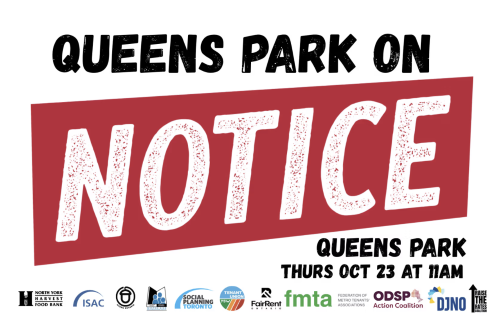
Community advocacy group NOTICE will be holding the rally at Queen’s Park on October 23rd from 11:00am to 1:00pm. Wages have not kept up with inflation, while rent prices continue to soar, making the cost of living increasingly unaffordable for workers. The Raise the Rates rally is demanding a rent freeze, and an increase to wages. SPT is co-sponsoring the rally alongside North York Harvest Food Bank, York South Weston Tenant Union, and other community organizations. Lunch will be provided at 11:30 while supplies last. Learn more and RSVP.
TTCRiders Launches a New Campaign Urging Toronto to Consider Farecapping
The TTC is looking at introducing fare capping in 2026 as part of their Ridership Growth Strategy. This means that riders will no longer be charged fares after taking a certain amount of trips in a month. Fare capping, which has already been successfully introduced in other major cities, will make transit much more affordable and accessible. The TTC is considering a fare cap of 40 trips a month, equal to $132.00 in adult fares and $94.00 in youth fares. Transit users will not have to pay the upfront costs for a monthly pass, and will be able to ride for free after 40 trips.
Transit advocacy group TTCRiders has launched a campaign urging Mayor Chow and City Councillors to include fare capping in the 2026 City budget. Use their email template to show your support.
Maytree Policy School Seeking Applications for 2026
Applications are now open for the 2026 Maytree Policy School. This six-month program, based in downtown Toronto, is designed for policy leaders in non-profit organizations that have an interest in developing and sharpening their skills in influencing public policy. Applications close October 15. Learn more.
New Report Examines a Hidden Part of Ontario’s Social Assistance System
The Social Planning and Research Council of Hamilton recently published the first ever report dedicated to Personal Needs Allowance (PNA), a hidden part of Ontario’s social assistance system. At only $149/month and frozen since 2019, the PNA is the only personal income for tenants in residential care facilities. The report shows how the PNA has lost half of its value since 1992.
SPRC Hamilton will be hosting an online community consultation surrounding the launch of the report on Tuesday, October 14, from 12:30 - 1:30 p.m. Learn more and register.
Survey: Disability Without Poverty Seeking Feedback on Monthly Expenses
Advocacy group Disability Without Poverty is interested in learning more about Canadians’ experiences with the Canada Disability Benefit (CDB) and personal monthly expenses. Their survey is open to anyone who receives the CDB, and can be completed once a month. Learn more.