
On May 22, 2025, Toronto City Council voted to approve a bylaw that may limit demonstrations outside of places of worship, schools, and child care centres. The Proposed Bylaw Amendment to Provide Access to Social Infrastructure will go into effect on July 2, 2025 and will allow owners of places of worship, schools, and child care centres to apply for the City to enforce a one-year, 50-metre access area to prohibit specific activities tied to demonstrations outside of their property. The bylaw will impact at least 3,000 institutions across Toronto, and could lead to fines of up to $5,000 under the Provincial Offences Act.
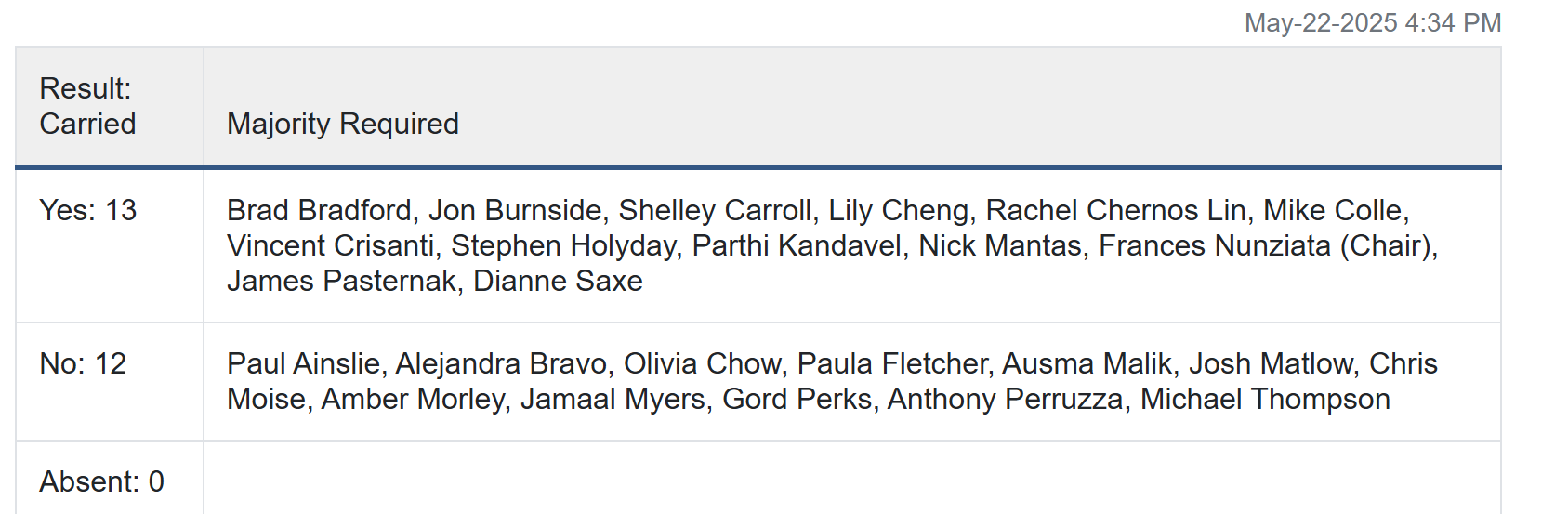
Breakdown of votes for an amendment to the bylaw, which would see the bubble zone expanded from 20 metres to 50 metres.
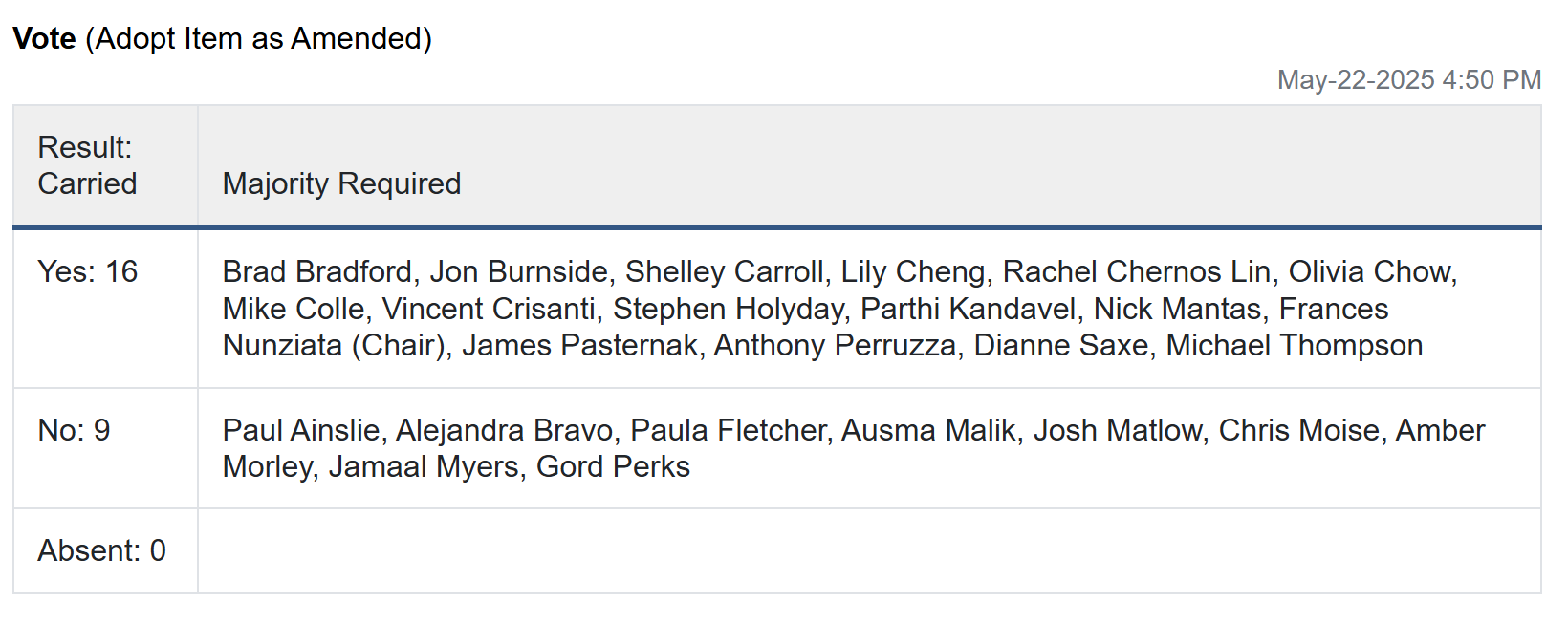
Breakdown of votes to adopt the bubble zone bylaw as amendment. For a full breakdown of all amendments and votes, visit the agenda item’s homepage.
Of the 42,747 respondents who participated in the City’s consultation on the bubble zone bylaw, 63% were unsupportive of such a bylaw. Additionally, there was an impressive response from residents and community groups who then contacted the Mayor and City Council directly, speaking against any kind of bubble zone bylaw. This included, by our count, 184 civil society groups, made up of faith-based institutions, labour groups, settlement and community nonprofit organizations, lawyers and legal institutions, health centres, women’s rights organizations, and grassroots. It also included 8 Jewish groups/organizations and 10 multi-faith groups. Most of the communications from these community groups to City Council have been published on the agenda item’s webpage.
The collective pressure of community led to City staff presenting a draft bylaw amendment to Council that was narrower in scope than we have seen in other municipalities. The draft bylaw amendment would still limit Charter rights and freedoms, but with some mitigating measures (as outlined in the Table below, under Proposed Toronto Bylaw). Despite these measures, Social Planning Toronto maintained that the proposed bylaw amendment was either unnecessary or unconstitutional.
Despite the majority of Torontonians opposing the bylaw, City Council voted to water down many of the mitigation efforts and expand the bylaw to further infringe on people’s right to protest. While the approved bylaw is not as extreme as the bylaw established in the City of Vaughan, it is still a critical concern for our Charter rights and risks having a chilling effect on demonstrations. The following table demonstrates the difference between Vaughan’s Protecting Vulnerable Social Infrastructure Bylaw, Toronto’s Proposed Bylaw Amendment to Provide Access to Social Infrastructure (prepared by City staff) and Toronto’s approved bylaw (approved by City Council):
|
Bylaw Comparison |
Vaughan Bylaw |
Proposed Toronto Bylaw |
Approved Toronto Bylaw |
|
Institution |
Any vulnerable social infrastructure, such as a place of worship, school, childcare centre, hospital or congregate care facility. |
Places of worship, schools, and child care centres. |
Places of worship, schools, and child care centres. |
|
Distance |
100 metres |
20 metres |
50 metres |
|
Active Period |
Indefinite |
180 Days |
1 Year |
|
Maximum Fine |
$100,000 |
$5,000 |
$5,000 |
|
Application |
Automatic (No application) |
Application with attestation* that a prohibited activity took place within the last 90 days and within 20m, that access has been impeded, and that it will occur again. *False, inaccurate, or misleading requests will lead to the rescinding of an Access Area. |
Application with attestation* that an owner reasonably believes a prohibited activity may occur. *No consequences for false, inaccurate, or misleading requests. |
|
Prohibited Activity |
Any and all demonstrations that “intimidate, incite hatred, violence, intolerance or discrimination.” |
Perform an act of disapproval concerning a person’s attendance or use of the Social Infrastructure. Persistently request that a person refrain from accessing Social Infrastructure. Obstruct, hinder or interfere with another person’s access to the Social Infrastructure Express an objection or disapproval towards any person based on identity. |
Perform an act of discouragement concerning a person’s attendance or use of the Social Infrastructure. Persistently request that a person refrain from accessing Social Infrastructure. Obstruct, hinder or interfere with another person’s access to the Social Infrastructure Express an objection or disapproval towards any person based on identity. |
|
Prohibition |
Indefinite. |
During operating hours (including 1 hour before and after operating hours) when the social institution is being used by the Owner for the primary purposes of its operation as a Childcare Centre, Place of Worship or School. |
During operating hours (including 1 hour before and after operating hours) when the social institution is being used by the Owner for the primary purposes of its operation, including where the Childcare Centre, Place of Worship or School is co-located with other uses. |
See a detailed breakdown of all the motions, if they were approved, and how Councillors voted.
What is at risk under the new bylaw?
While the approved bylaw states that it will not prohibit peaceful gatherings, protests, or demonstrations, including any activities that are part of a labour union strike, information pickets, or activities related to labour disputes, it is structured to do just that. If the operator of a place of worship, childcare centre, or school believes that an individual or a group may at some point in the future “perform an act of discouragement concerning a person’s attendance or use” or “express an objection or disapproval towards any person based on identity”, they will have the power to limit that group’s Charter rights. This is a very low bar that they would be required to clear; protests, strikes and pickets are, by their very nature, acts of disapproval, discouragement, or objection.
Some of these elements were changed from the original bylaw amendment introduced by City staff and the impacts of these changes are still unclear. According to the Toronto Star, who obtained a confidential legal report around the bubble zones, some legal experts say these changes make the approved bylaw less likely to withstand a constitutional challenge.
What are our rights under the new bylaw?
There is a legitimate concern that this bylaw and any further attempts to limit dissent, including peaceful protests, will impact social movements, and may result in community members feeling unable or unsafe to demonstrate peacefully. Despite the bylaw, residents still have the right to demonstrate across the rest of the City, as well as the right to carry out defined activities within the access areas, and should continue to do so. Here are some insights on what is permitted under the new bylaw:
What kinds of activities are permitted within an access area?
The approved bylaw states that it will not prohibit peaceful gatherings, protests or demonstrations, including any activities that are part of a labour union strike, information pickets, or activities related to labour disputes. However, the interpretation of this bylaw is still unclear. For example, two of the prohibited activities are already against the law, and the other two are vague - using the language of discouraging, objecting, or disapproving—and could lead to a Charter challenge as they fall under the umbrella of peaceful demonstrations and the right to free speech.
If you are concerned about your rights under this new bylaw, here are some legal resources for you to connect with:
- Canadian Civil Liberties Association has downloadable resources
-
Centre for Free Expression (Toronto Metropolitan University)
Contact: (437) 995-7396 |[email protected]
-
The Legal Support Committee, a collective of community organizers committed to standing in solidarity with individuals targeted by criminalization in the Greater Toronto Area
Contact: [email protected]
-
Pro Bono Ontario, a free legal advice hotline
Contact (toll free): 1-855-255-7256