
It’s a major victory for public transit riders. After years of community advocacy, plans are underway to introduce a fare capping program to make transit more affordable, increase convenience and fairness for riders, and attract more riders back to the TTC. Fare capping is a transit affordability model that has been successfully adopted in many areas across Canada, including Hamilton, Durham Region, York Region, Ottawa, Edmonton, Mississauga, and Brampton, and in U.S. cities, such as New York City, Los Angeles, Portland (Maine), Portland (Oregon), and Dallas.
If passed, the City budget will support the introduction of fare capping starting on September 1, 2026, when riders will stop being charged after 47 paid rides in a calendar month and all rides after the 47th will be free. The budget includes funds for fare capping, a third year of TTC fare freezes, expansion of transit services, and community crisis prevention workers to aid individuals in distress on public transit.
While much attention has been paid to fare capping as an affordability measure, a means of supporting ridership growth, and a program to advance transit equity, little has been said about its benefits to low-income transit riders under the Fair Pass Transit Discount Program. Under the proposed fare capping plan, low-income discount fare riders who take at least 47 trips a month will save the most out of all transit rider groups.
Savings for Transit Riders Under Fare Capping
Under the proposed plan, the monthly cap of 47 paid rides will apply to Adult, Youth, Senior, and Fair Pass fares. Monthly passes for these fare categories will be replaced with automatic fare capping. This change allows riders to have the benefits of a monthly pass without having to pay the full cost upfront for a pass at the same time major expenses like rent are due. Notably, the plan leaves out any changes to post-secondary students, who will still need to pay expensive upfront costs for a monthly pass. We support calls for a lower post-secondary student fare in this year's budget.
If the proposed plan is supported by the Mayor and Council, fare capping will make a significant contribution to advancing Toronto’s Poverty Reduction Strategy. As shown in the table below, low-income transit riders under the Fair Pass program will benefit the most from fare capping. At 47 taps, the maximum monthly charge for Fair Pass riders will be $98.70 with a monthly savings of $24.45—a nearly 20% discount on the cost of a Fair Pass.
It is a significant savings over the costly Fair Pass at $123.15 per month which is out-of-reach for many low-income riders. In fact, Fair Pass riders will be paying less under fare capping in 2026 than they did when the Fair Pass was first introduced in 2018 at $115.50 per month.
The TTC Board has endorsed a plan to decrease the fare cap to 40 rides per month starting on September 1, 2027, deepening affordability for transit riders with the greatest savings again for Fair Pass riders. Using current fare costs, at 40 taps, the proposed maximum monthly charge with fare capping is set to drop to $84 for Fair Pass riders, with a savings of $39.15 per month—a nearly 32% discount on the current cost of a Fair Pass. It has been well over two decades since an adult monthly pass (the “Metropass”) was that price.
Fare Capping Savings by Fare Category
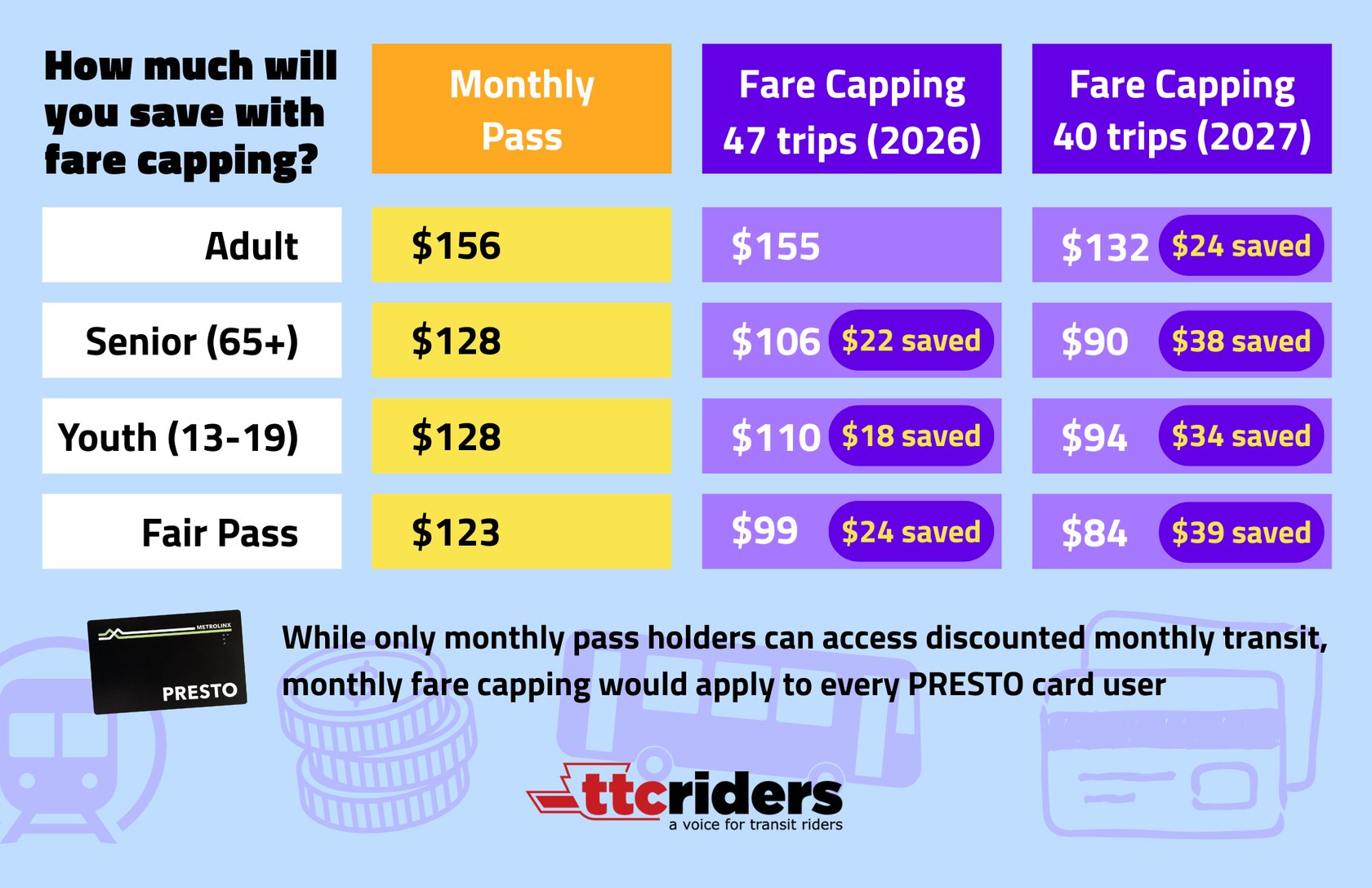
Significant Growth in Use of Discount Single Adult Fares, While Monthly Fair Pass Purchases Stall
TTC data demonstrates that the monthly Fair Pass is not delivering on its promise of affordable transit for many low-income residents. According to data accessed by TTCriders through a freedom of information request, use of discount single adult fares grew at a slightly higher rate than monthly Fair Pass purchases during the pre-pandemic period. During the pandemic, there was a considerable and expected decline for both. However, since the pandemic, use of discount single adult fares has grown substantially, surpassing pre-COVID levels. In contrast, growth in the purchase of monthly Fair Passes has been much slower and has not recovered to pre-pandemic levels as of June 2024.
The stagnant growth in the purchase of monthly Fair Passes is not surprising given its high cost. Fair Pass users need to take 59 trips in a month to break even on a $123.15 low-income monthly pass—compared to 49 trips for the adult monthly pass. Yet in 2022, the average person using the Fair Pass only took 9 trips per month on the TTC. The requirement to pay upfront for a transit pass at the beginning of the month is a further barrier for low-income residents.
Fare capping offers more affordable transit for frequent transit users with low incomes without having to cover the costs of a pass upfront. According to the 2026 City budget, 113,500 individuals are expected to be active participants taking over 16.6 million trips through the Fair Pass Transit Discount Program (monthly Fair Passes and single discount fares), including those using the TTC under the fare capping program in the latter part of the year.
Who’s Eligible for the Fair Pass Transit Discount Program?
The current TTC Fair Pass Transit Discount Program offers discount single fares (saving cardholders 36% on TTC single adult rides) and discount monthly passes (saving 21% on TTC adult monthly passes). To qualify for the program, residents must meet the following criteria:
- live in the City of Toronto;
- be 20-64 years old;
- meet the program’s definition of low-income, and;
- have a PRESTO card number.
The program uses 75 per cent of the Statistics Canada’s Low-Income Measure After-Tax to determine income eligibility. For example, a net income below:
- $20,514 for a one-person household;
- $29,011 for a two-person household;
- $35,531 for a three-person household; and
- $41,028 for a four-person household meets the low-income criteria.
Only persons aged 20-64 are included in the net income calculation. All residents receiving Ontario Works (OW), Emergency Assistance, and Ontario Disability Support Program (ODSP) meet the income criterion.
We continue to advocate for free transit for people receiving social assistance. In 2022, TTC staff told Councillors that while the Fair Pass program "is important and helpful, it's still very high for low income folks to be able to access," and reported that staff were considering creating a 4th phase that would deepen the discount.
TTCriders surveyed all candidates during the 2022 Municipal Election and the 2023 Mayoral By-Election and secured commitments from many elected representatives to “begin implementing fare free public transit, starting with people who receive social assistance, high school students, and on extreme weather alert days”.
Tell City Council: Fund Fare Capping & Invest in Reliable, Safe, and Affordable Transit in the 2026 Budget!
TTCriders, SPT, many community partners and transit riders have called for a deeper discount to make transit more affordable to low-income riders. If supported, fare capping will be a major step forward in supporting transit affordability and advancing Toronto’s Poverty Reduction Strategy. Let’s get fare capping and other transit improvements funded in this year’s budget!
Send an email to your City Councillor using TTCriders’ quick and easy form.
| TAKE ACTION |
Join Us On February 10 for Our City Budget Rally
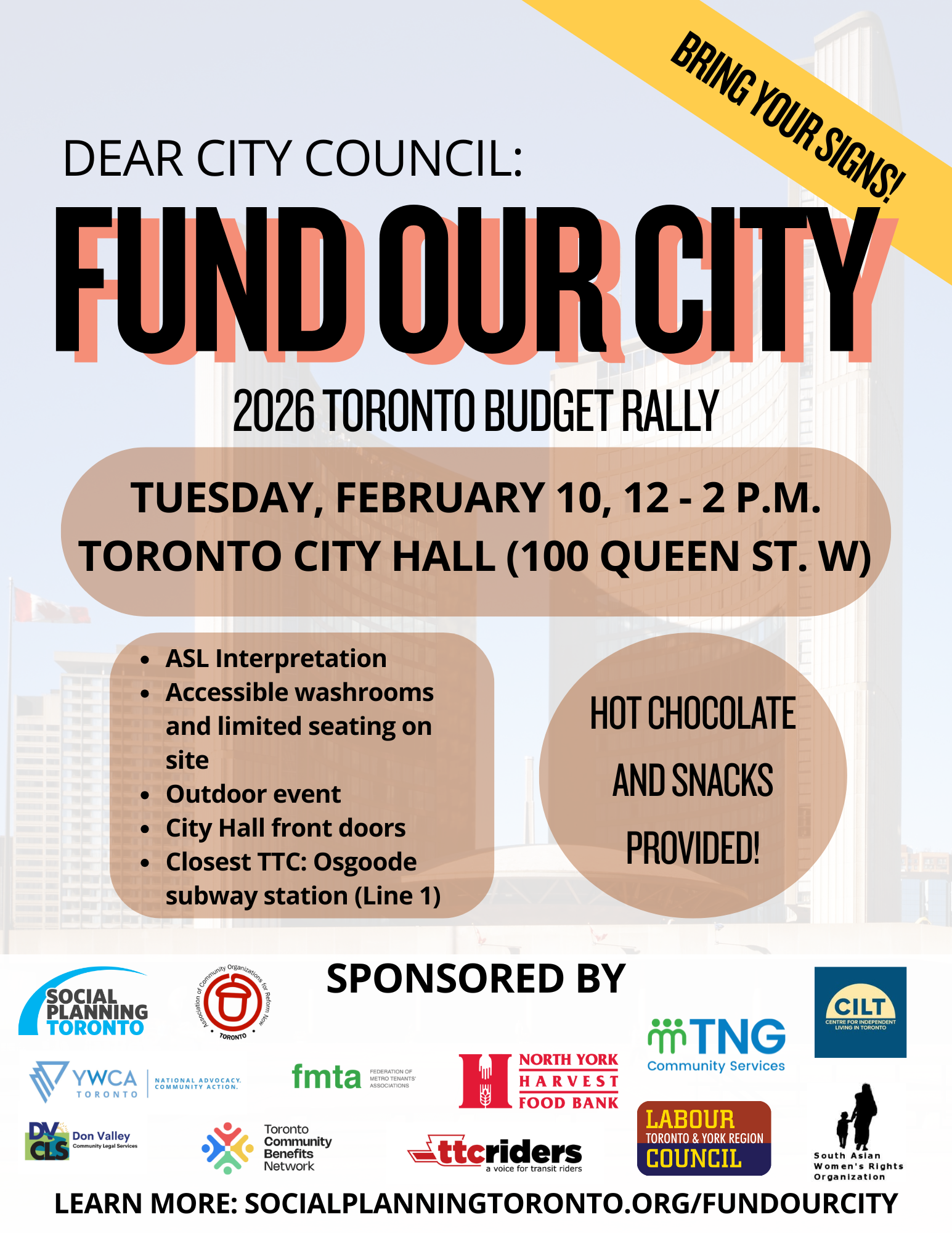
On February 10 from noon to 2 PM, Social Planning Toronto and our City Budget Coalition partners will host Fund Our City, our annual City Budget Rally at City Hall. Come out and stand with us for a stronger, more inclusive Toronto. Learn more and RSVP.
Learn More
- Read TTCriders’ budget analysis
- See the TTC’s presentation to the Budget Committee
This post was jointly produced by TTCriders and Social Planning Toronto.