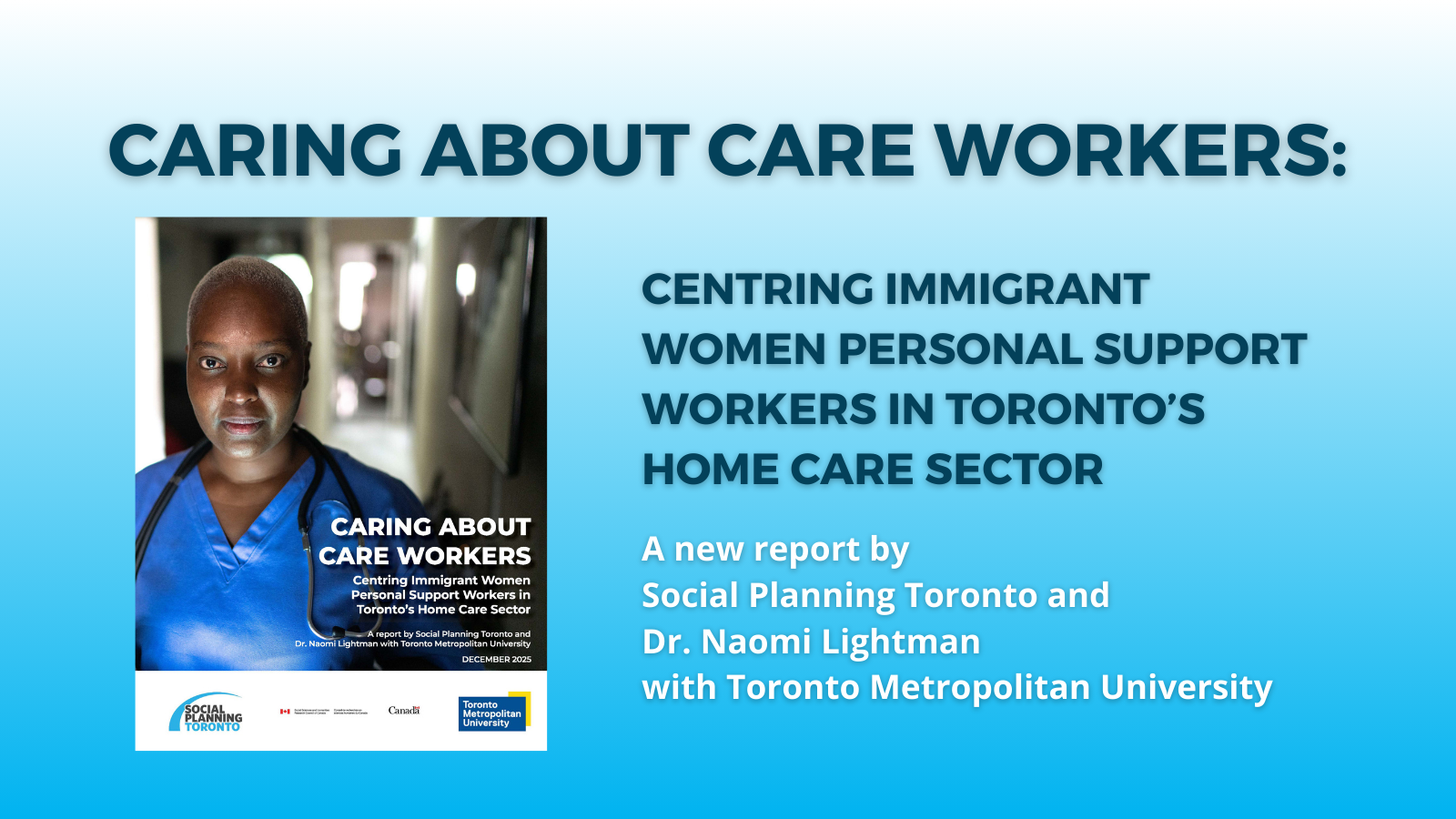
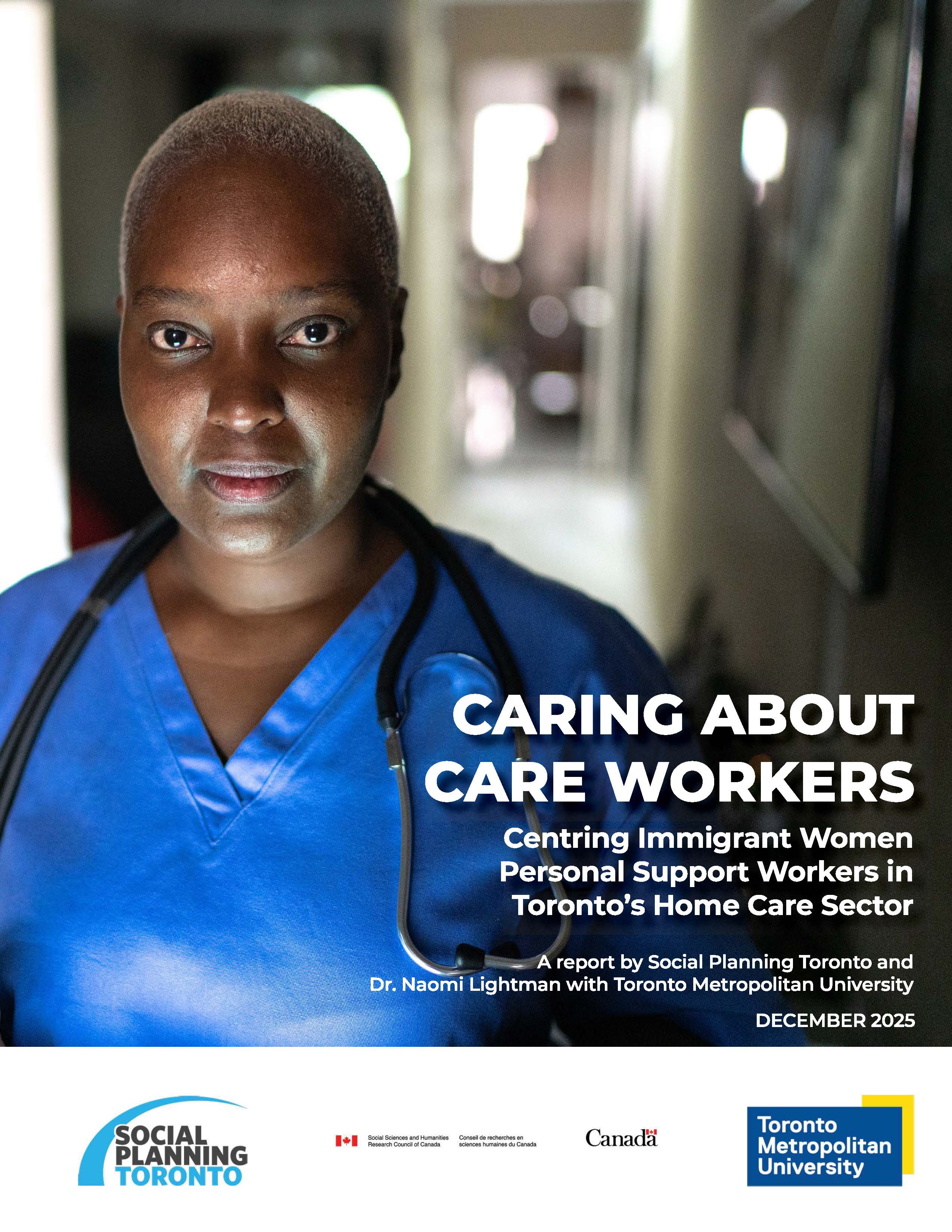
Caring about Care Workers: Centring Immigrant Women Personal Support Workers in Toronto’s Home Care Sector is a partnership between Social Planning Toronto and Dr. Naomi Lightman of Toronto Metropolitan University.
 Executive Summary
Ontario’s home care system is in crisis, with severe negative impacts for both workers and care recipients. Home care helps seniors to live in their own homes longer, facilitates the autonomy of people with disabilities, and aids in the recovery of individuals following a hospital stay. Yet it is routinely neglected and chronically under-resourced. This scenario leads to significant unmet home care needs, distress among a large portion of unpaid caregivers, and threats to the viability of the sector.
Personal Support Workers (PSWs) are the backbone of Ontario’s home care system, providing the majority of home care services. In 2022, an estimated 28,854 individuals were employed as PSWs in Ontario’s home care sector. Home care PSWs collectively provided 36.7 million hours of care to Ontarians in 2023–24 through the provincially funded home care system. Provincial projections show 50,853 additional PSWs will be needed across all sectors by 2032, pointing to mounting labour shortages in the years to come. Home care PSWs do essential labour supporting home care recipients and their families, while also reducing pressure on hospitals, emergency departments, and long-term care homes.
Despite their critical role, PSWs’ home care labour is characterized by:
-
low wages;
-
lack of employment benefits;
-
lack of sufficient, stable, and predictable work hours and incomes;
-
health and safety risks;
-
experiences of harassment, discrimination, and violence on the job;
-
inadequate workplace protections; and
-
unique challenges associated with working alone in private homes.
Inadequate provincial funding and inequitable and restrictive funding arrangements are the primary drivers that create and exacerbate these conditions.
Immigrant and racialized women are disproportionately represented among home care PSWs and comprise the majority of home care PSWs in the Greater Toronto Area (GTA). These skilled, knowledgeable, and dedicated workers are impacted by a system that relies on their essential labour while also deeply undervaluing their work. Home care PSWs are especially vulnerable due to the frontline nature of their employment, and they experience intersectional disadvantage due to their citizenship status, race, gender and/or class.
In this research study, interviews were conducted with 25 immigrant women working as PSWs in the home care sector in the city of Toronto. These interviews examined the working conditions and lived experiences of home care PSWs. Interviews were also conducted with seven individuals engaged in labour and community organizing pertaining to PSWs and home care.
The research is a collaboration between Social Planning Toronto and Professor Naomi Lightman of Toronto Metropolitan University.
Altogether, the interviews with immigrant women PSWs in home care point to a dire situation for workers and clients alike. Without transformative action, things will only get worse.
Four key themes emerged from the research
Key Theme #1:
PSWs Are Subsidizing Ontario’s Home Care System With Their Unpaid Labour
Not only does Ontario’s home care system heavily depend on the underpaid care work of PSWs, it also relies on their unpaid labour. Our research found that PSWs — the lowest paid workers in home care and disproportionately comprised of racialized and immigrant women — are subsidizing the provincial home care system with their unpaid labour in an effort to provide clients with high-quality care and to cope with unmanageable demands of the job. Using their personal unpaid time, PSWs are working off the clock to provide adequate care to clients. On the frontlines of people’s suffering, home care PSWs are working to fill the deep deficiencies in Ontario’s home care system with their unpaid labour.
Key Theme #2:
The Provincial Home Care System Offloads Costs Onto PSWs
Precarious employment is widespread in the home care sector. Research participants explained that they:
- receive low or no pay for their travel time;
- are not fully reimbursed for travel costs;
- often experience long gaps of unpaid time between client visits;
- routinely have their work hours reduced;
- lose hours when clients move, enter hospital or long-term care homes, or pass away; and
- often return to reduced hours after a vacation or extended leave.
Insufficient provincial funding and an antiquated and inequitable funding model based on a standard hourly rate for personal support services creates these conditions, with adverse effects on PSWs and home care clients alike. As a result, costs associated with the normal functioning of home care provision are offloaded onto home care PSWs, and risks inherent to the system are borne by these workers.
Key Theme #3:
Home Care PSWs Face Serious Health and Safety Risks
Home care PSWs raised many health and safety concerns, often tied to working alone without onsite support in private homes. Participants conveyed that they deeply value their relationships with clients and recognize home care recipients as some of their strongest allies. However, PSWs also discussed:
- traumatic experiences with some clients, where they were subjected to anti-Black racism, sexism, violence, and harassment;
- injuries incurred on the job;
- hazards of working in private homes;
- physical and mental impacts of working through the COVID-19 pandemic;
- inadequate access to paid sick time; and
- difficulties accessing Workplace Safety and Insurance Board (WSIB) benefits.
Participants’ experiences addressing health and safety issues with their employers varied. While some had positive experiences with employers, others felt their concerns were dismissed or left unaddressed. Provincial funding and policy decisions and workplace cultures and practices are central to the health and safety of home care PSWs.
Key Theme #4:
Low Wages, Precarious Employment, and Poor Working Conditions Drive Home Care Labour Shortages, With Grave Consequences for Ontarians
Ontario’s home care sector continues to experience staffing challenges, with high levels of PSW job turnover directly and adversely impacting access to quality care. Participants identified the major contributors to staff retention problems and the PSW labour shortage in home care, including:
- a lack of guaranteed work hours;
- inadequate work hours;
- low wages;
- lack of wage parity for PSWs across sectors; and
- poor working conditions.
A failure to address the staffing shortage will create greater stress and strain on home care PSWs, driving more workers out of the sector, intensifying the crisis, and resulting in dire consequences for home care clients, while the demand for services increases with the aging population. Further, when home care is not available, people turn to more costly forms of care — hospitals, emergency departments, and long-term care homes.
Three case studies are also presented to focus on specific pressing issues connected to the current home care crisis and examine viable pathways to improving home care PSWs’ working conditions and collective power.
Case Study #1:
Privatization and Profit in Ontario’s Publicly Funded Home Care System
To contextualize the current crisis in home care, we trace its origins back to major provincial reforms of the late 1990s, when service delivery was privatized and opened to for-profit companies. Market-based competitive bidding, severe rationing of home care services, and privatization and profit-making destabilized the home care system, to the detriment of home care workers, recipients, and their families, disproportionately impacting women. Despite subsequent policy changes, precarious employment and ongoing staffing shortages remain the norm, with large home care companies extracting millions in private profit.
Case Study #2:
The Future of Ontario’s Publicly Funded Home Care System
In this case study, we explore the potential of a public-nonprofit home care system to replace the current privatized model, noting that every public dollar for home care is needed to provide high-quality care for Ontarians, and fair compensation, secure employment, and good working conditions for PSWs and other home care workers. The case study concludes with a look at the potential of nonprofit home care worker co-operatives, operating within a public-nonprofit system, to provide high-quality care while centring the concerns of home care PSWs.
Case Study #3:
The Role of Unions in Improving PSW Working Conditions and Building Workers’ Collective Power
Our research and other studies have documented the importance of unions as a vehicle for improving working conditions and building collective power among workers, including home care PSWs. To explore this issue further, we present an organizational interview with labour leader, community activist, and home care PSW Connie Ndlovu. Drawing on her over 20 years of experience in the home care sector, Connie reflected on inequities and injustices impacting home care PSWs, making clear connections between work conditions, quality of care, privatization and competition in home care, and provincial funding and policy choices. She emphasizes the benefits of being a union member and working in nonprofit organizations to counter injustices within the home care system.
Key Recommendations
We put forward three broad recommendations to address key concerns of home care PSWs, informed by this research, related studies, and engagement with community partners. In the full report, detailed proposals are presented under each recommendation, calling on the federal and Ontario governments, the Workplace Safety and Insurance Board (WSIB), home care service provider organizations, and the labour movement to take action. These recommendations are rooted in a deep respect for home care PSWs, an appreciation of the essential care work they provide to Ontarians, and an understanding of the integral relationship between conditions of work and quality of care.
1. Ensure Fair Compensation, Secure Employment, and Protections for Home Care PSWs
Proposals in this section focus on the responsibility of the provincial government to address key employment concerns of home care PSWs through increased funding, modernization of the home care funding model, and effective funding arrangements for the provision of home care services.
These concerns include the need for:
- wage parity for PSWs across sectors;
- guaranteed and reliable work hours;
- full compensation for all work hours, including travel time;
- access to employment benefits;
- protection of the health and safety of home care PSWs; and
- a sectoral strategy that engages service provider organizations to protect workers from anti-Black racism and other forms of discrimination in home care.
We also call for:
- better protections for injured workers, including home care PSWs, through WSIB;
- proposals for greater pandemic readiness to protect home care PSWs during public health emergencies; and
- the strengthening of anti-harassment and anti-racism organizational policies to protect workers from anti-Black racism and other forms of discrimination in the workplace.
2. Transform Ontario’s Home Care System to Support Good Working Conditions for PSWs and High-Quality Care for Ontarians
Transformational systems change is required to address the key employment concerns of home care PSWs and provide high-quality care for Ontarians.
Recommendations here focus on the critical need for systems change at the provincial level, including:
- the creation of a comprehensive public-nonprofit home care system, where home care workers, Ontarians receiving care, and their families play a central role in this change process;
- an end to private profit in the publicly funded home care system to ensure that every public dollar supports high-quality care and good working conditions for home care workers;
- adoption of a grant-based funding model for home care to better support the full cost of care provision;
- development of employment standards for home care PSWs; and
- improvement of public transparency and accountability in home care through data collection and analysis, regular public reporting, and independent research.
We also call on the federal government to:
- include home care as an insured service under the Canada Health Act;
- increase home care funding to provincial governments, where funding is tied to conditions such as improvements to compensation and working conditions for home care PSWs, access to care, and care standards for residents; and
- develop national home care standards to ensure access to high-quality care and good working conditions in home care.
We also recommend that the Auditor General of Ontario conduct an in-depth audit of Ontario’s publicly funded home care system, as the last significant audit was performed a decade ago. Performance audits assess value-for-money for taxpayers, waste, and misuse of public funds.
3. Build the Collective Power of Home Care PSWs
Home care PSWs recognize and have a clear understanding of the failings of the provincial home care system that adversely affect themselves as workers and their clients. PSWs are some of the strongest advocates for and allies with home care clients. Throughout the interviews, participants called for changes that would result not only in fairness for home care PSWs but also greater access to quality care for Ontarians.
To build the collective power of home care PSWs, we recommend strategies to achieve better wages and working conditions, as well as improve access to quality care for Ontarians.
We propose that:
- the provincial government reform labour laws to improve access and reduce barriers to unionization for home care PSWs who wish to join a union;
- the labour movement dedicate more resources to organize with home care PSWs, including paid organizing work for immigrant and racialized women who work as home care PSWs;
- community foundations and organizations support PSW networks and leadership development opportunities for home care PSWs;
- government, labour, and community sector groups develop and expand educational campaigns and programs to increase PSWs’ awareness of their rights as workers and of supports and avenues available to exercise those rights;
- governments and community foundations support solution-focused research and the creation of promising workforce development practices to promote decent work in the home care sector; and
- senior orders of government support the development of nonprofit home care worker co-operatives as an alternative employment model.
Thank You to Our Research Participants
We are deeply grateful to the PSWs who generously shared their time and expertise with us. These strong, intelligent, and committed women expressed an urgent need for transformational change in home care — to address the needs of Ontarians and achieve fairness and justice for PSWs like themselves. This report highlights the voices of PSWs — a group historically left out of public conversations about system reform.