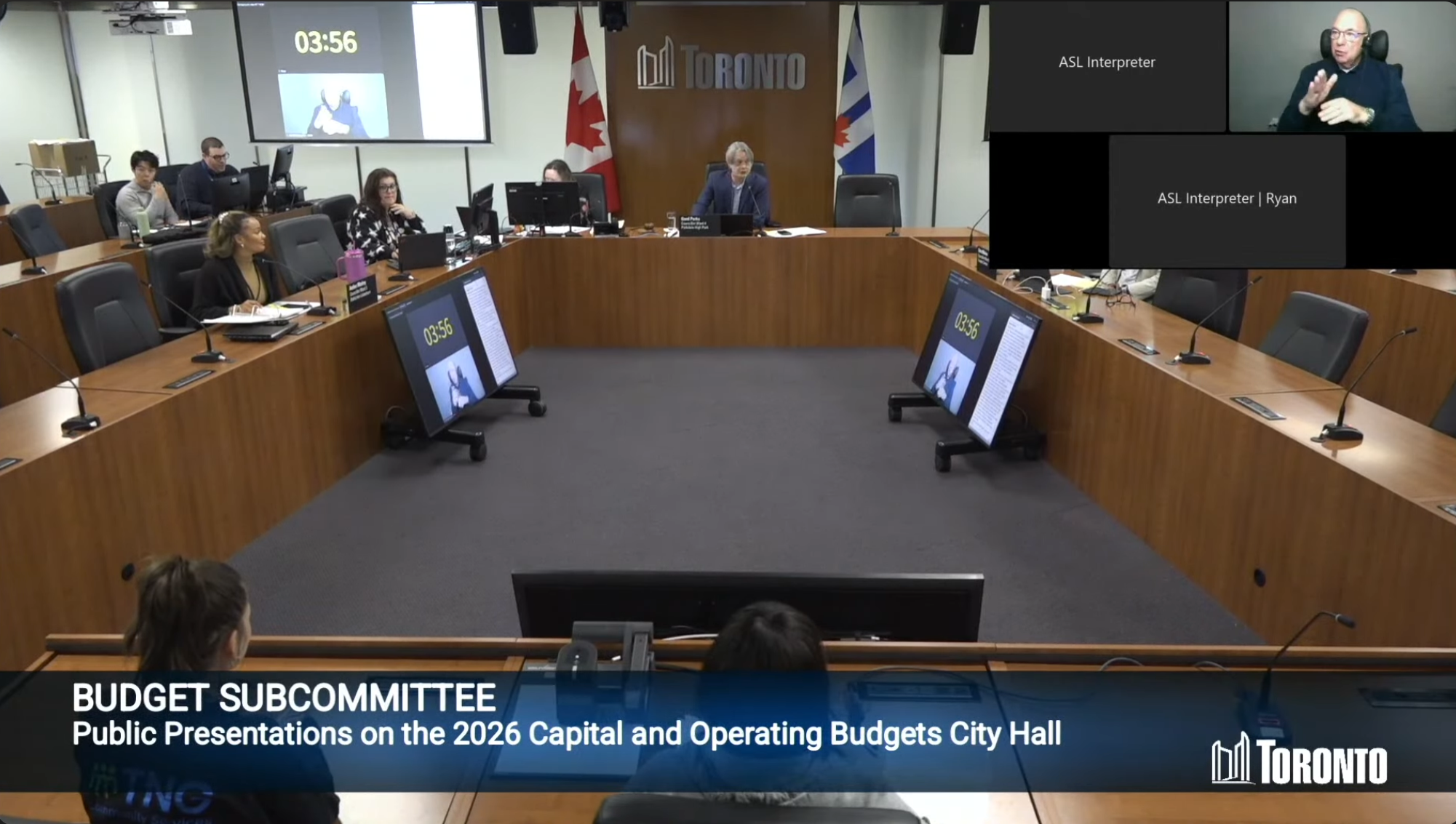
On January 20 and 21, 202 residents, community agencies, and advocacy groups participated in public hearings on the 2026 City Budget, sharing their ideas, concerns, and calls for action directly with members of the Budget Committee. Deputants took part in public hearings online and in person at four locations across the City: Toronto City Hall, and the Etobicoke, North York, and Scarborough Civic Centres. Many participants braved extreme cold to deliver their powerful messages in person.
Throughout the public hearings, affordability emerged as a prominent and consistent theme, with strong calls for the continuation and expansion of investments in areas critical to Toronto's social and economic future. Deputants advocated for sustained and deepened investments in our essential public and community services. Key priorities included affordable, accessible, and supportive housing; youth programs and community safety; affordable public transit, food security, library open hours; community and arts programs and services; and climate action. There were recurrent calls to reallocate funding from the police budget toward social services and community-based supports. Participants also spoke about the need for long-term, sustained, and sufficient revenues to build a better city.
Several speakers commented on positive changes at City Hall, with the prioritizing of community well-being through public investments, while also recognizing the need for the City to intensify and expand efforts in the face of deep inequities, crisis, and hardship impacting Toronto residents.
All quotes were taken from public deputations (available to watch on the City of Toronto’s Youtube Channel), and may have been lightly edited for length and clarity.
Affordable, Accessible, and Supportive Housing
I am a resident of Dunn House, Canada’s first social medicine building and as a result of its success I’m pleased with yesterday’s announcement that Dunn House Phase 2 has been approved. When completed 54 more people will be moving off the streets, out of hospital and into stable permanent supportive housing. While this is news to be celebrated we all need to be mindful that there is still more to do […] Housing is still very much a growing problem.
Prior to moving into Dunn House, I spent many years homeless battling addictions and years in and out of jail for committing crimes, mostly out of desperation. That has since changed. My brushes with the law are a thing of the past. I’m thriving again now that I am housed. I’m more than two years clean and sober from drugs and alcohol, and this past November I started my first job after several years, working for the City of Toronto on the Lived Experience Advisory Group. While it was me that did the hard work, these are strides I was able to take having found supports and stable housing. I’m now very active in my community and contribute wherever I can. This is why I think it’s so important that we look at where we are spending money and choose to spend it where it is most needed.
—Jason Miles, budget deputant, participant in SPT’s Deputations 101 workshop, and resident of Dunn House
The housing crisis was consistently identified as one of Toronto’s most urgent challenges. While deputants acknowledged the City’s investments in the Rent Bank, eviction prevention and other tenant supports, many argued these measures are insufficient. Speakers called for a significant expansion of affordable, accessible, and supportive housing, particularly to address the needs of unhoused and encampment residents across the city. Community members also made strong appeals for the Mayor and City Council to increase advocacy with the federal and provincial governments
Youth Programs and Community Safety
One of my biggest frustrations in the 20 plus years I’ve been involved in supporting community is that the security of this work is tenuous. The work that we do is too often perceived as work to be done as charity […] I want to be clear today that this work that we do is not charity. This is investment. We are investing in these youth in their potential and ultimately in the future of Scarborough.
Research has shown that communities that invest in violence intervention, cognitive behavioural support, and wraparound services see shooting instances decrease by about 14% in communities, compared to those that haven’t received any intervention. That’s not symbolic. That’s lives spared, that’s families kept whole, and that’s futures preserved. TO Wards Peace isn’t just about reducing numbers on a report. It’s about changing the direction of a young person’s life before crisis becomes tragedy.
—Sheldon Pitt, aka hip-hop artist Solitair, budget deputant, violence disruption worker with TO Wards Peace
Many organizations and community members advocated for continued and stable funding for youth mentorship, employment, and violence prevention programming. Several participants expressed their support for the TO Wards Peace Program, a community-centred, multi-sectoral initiative with a proven track record in successfully disrupting violence and promoting community safety.
TO Wards Peace operates in various parts of the City. The Scarborough-based component has been supported through federal funding, and it is one of several violence prevention programs at risk due to the expiration of this funding. These programs are critical supports for interrupting, intervening, and preventing gun violence while addressing systemic barriers faced by young people. Deputants warned that without stable, ongoing funding, gains from these important programs would be lost, with serious consequences for youth and the broader community.
Many residents and groups also called for a more holistic, non-police-centred approach to community safety, reducing reliance on policing and increasing investment in community services. In particular, speakers supported the expansion of community crisis prevention workers, including workers providing support to individuals in distress on public transit. Deputants emphasized the importance of investments in prevention and support services, noting the role they take in addressing root causes of poverty and strengthening communities. These approaches were framed as essential components of a proactive, community-centred safety strategy.
Affordable Public Transit, Food Security Initiatives, and Library Open Hours
I'm here to speak on how the expansion of the student nutrition program and increasing access to healthy foods across Toronto are needed and must come with provisions to truly address the gaps the program currently experiences. I'm grateful that the program is proposed to increase […] and I urge the council to approve this much-needed funding.
—Uthish Ganesh, budget deputant, teacher at Winston Churchill School
The City can build on the success of the continuing fare freeze by introducing fare capping, a policy that could save transit riders like me hundreds of dollars every year. It is great to see fare capping introduced in the budget, but I'd hope to see the city roll out the program even faster with a lower threshold, as fewer rides before they get to enjoy free rides for the rest of the month.
—Alex Salton, budget deputant, public transit rider
Many participants supported budget commitments for affordable public transit and food security. Residents called for an earlier implementation of fare capping, an important new transit affordability program not set to start until September 1, 2026, and supported the City’s commitment to a third year of TTC fare freezes. Under fare capping, adult, youth, and senior riders will pay for a maximum of 47 rides per month, after which additional trips are free, with a plan to reduce the cap to 40 rides per month in 2027. Participants also expressed strong support for measures in the budget to significantly expand the Student Nutrition and CampTO Nutrition programs and to implement the third and final phase of Toronto Public Library’s Open Hours plan, with all 100 branches operating 7 days per week by the Summer of 2026.
Climate Action
—Sarah Buchanan, budget deputant, Toronto Environmental Alliance
Many deputants raised concerns about the climate crisis and its growing impact on public health and community well-being. Speakers emphasized the need for increased municipal investment in climate mitigation and adaptation strategies, highlighting the disproportionate effects of environmental degradation on low-income and marginalized communities. Deputants called on Toronto City Council to fully fund the TransformTO Net Zero Strategy, a Council-endorsed plan to reduce greenhouse gas emissions to net zero by 2040, and invest more in renewable energy and sustainable transportation.
Reallocating Funds from the Police Budget to Support Proven, Proactive, Community-Based Safety Initiatives
The TPS budget could be reallocated into the following streams: increased wages for public health nurses as many of the speakers beforehand spoke on; increased funding towards unhoused outreach and transitions to supportive housing; renter protections; funding towards the expansion of crisis response teams, safe beds and intensive care management; as well as funding towards youth outreach and opportunities, in addition to funding towards alternatives to gender-based violence.
—Eric Shatosky, budget deputant
Concerns with the Toronto Police Service budget remained a central theme in this year’s deputations, with several participants commenting on the lack of meaningful public input in funding decisions. Deputants called for the reallocation of funding from the police budget to effective, proactive community-based safety initiatives. Speakers highlighted alternative safety models, including those being implemented on the TTC, that integrate frontline staff and mental health workers rather than rely on enforcement-based approaches. Deputants also supported the development of civilian-led services as better approaches to many issues currently handled by the police. A 2022 Toronto Auditor General’s report identified 6 event types—check address, check well-being, dispute, noisy parties, landlord and tenant dispute, and unwanted guest—that could potentially be handled by a non-police responder if alternative services were available, saving an estimated 85,000 police hours over 5 years.
Raising Revenues for a Better City
Several residents and groups spoke about the ongoing need for long-term, sustainable, and sufficient revenue to fund a better city. Some deputants criticized the 2.2% property tax increase as inadequate to raise necessary revenues. Many pointed to the City’s limited avenues for revenue generation and emphasized the responsibility of provincial and federal governments to provide sustained funding. Concerns were raised about the expiration of the New Deal between Ontario and Toronto at the end of 2026, uncertainty surrounding future funding of key programs, services, and infrastructure, and the urgent need for structural funding changes for major municipalities.
Throughout the deputation sessions, residents and community groups made a strong and impactful case for Toronto City Council to build on significant investments from recent years and to continue, expand, and accelerate investment in vital services. Participants identified urgent community needs across the city and the need for the City to meet its commitments to advancing human rights, equity and affordability in this year’s budget.
Budget Committee Makes Recommendations for the Mayor’s Budget
Informed by the public hearings, the Budget Committee met on January 23 to make recommendations to the Mayor, identifying priorities to inform her budget. Mayor Chow’s Budget will be released by February 1, with final votes at City Council on February 10.
Read SPT’s post on the Budget Committee’s Recommendations to the Mayor.
This post was researched and authored by Rebecca Smith, SPT placement and TMU social work student.