
On Sunday, February 1, Mayor Chow released the Mayor’s 2026 City Budget. The Mayor’s Budget makes modest improvements to the staff-prepared budget and safeguards hundreds of millions in investments in public and community services introduced in recent years. The Mayor’s Budget increases:
-
funding for seniors services by $1.2 million; these funds will support the Homemakers and Nurses Services program which “help(s) with day-to-day tasks like cleaning, cooking and personal care, so that seniors can get the help they need to stay in their homes and neighbourhoods”—increasing this budget to over $7 million, allowing the service to eliminate its 18-month waiting list for these critical supports for seniors—and expand financial management services for vulnerable seniors;
-
funding for the Downtown East Action Plan by $542,000; this plan sets out “actions to coordinate City services and address intersecting challenges in Toronto’s Downtown East area related to poverty, homelessness, community safety, mental health, substance use and the drug toxicity crisis”; and
- the property tax discount for small businesses to 20%—up from the current 15% discount rate—through a greater reliance on property tax revenue from larger businesses.
The tax increase for residential property has remained unchanged at 2.2%, made up of a 0.7% property tax increase and a 1.5% increase to the City Building Fund, which supports affordable housing and public transit infrastructure. The Mayor’s Budget includes $2 million in unallocated funding. Toronto City Council will decide how to use these funds at its February 10 meeting.
New and enhanced services in the 2026 staff-prepared budget and supported in the Mayor’s Budget advance Toronto’s Poverty Reduction Strategy through investments in:
- tenant supports and eviction prevention;
- student nutrition programs and the CampTO nutrition program;
- TTC fare capping and community crisis support on the TTC;
- financial and social support programs and 7 day-per-week open hours at all Toronto public libraries; and
- complimentary school trips to the Toronto Zoo.
Read our previous post for all the details on new and enhanced services included in the staff-prepared budget and maintained in the Mayor’s Budget.
By our calculation, the Mayor and City Council have invested more than $266 million in new and enhanced services, including over $200 million from City revenues, through the 2024 and 2025 City budgets—plus additional investment in capital programs, such as the Multi-Unit Residential Acquisition (MURA) program. These investments form part of the base budget in 2026 and future years.
The 2026 Mayor’s Budget protects these critical investments and builds on them with targeted funding to introduce and expand key services.
Check out our City Budget Watch blog for:
- in-depth budget analysis on the 2026 City Budget;
- highlights from community deputations; and
- recordings from our Budget 101, Deputations 101, Housing Advocacy Workshop, and Budget Town Hall with community partners.
Take Action for a Better Budget!
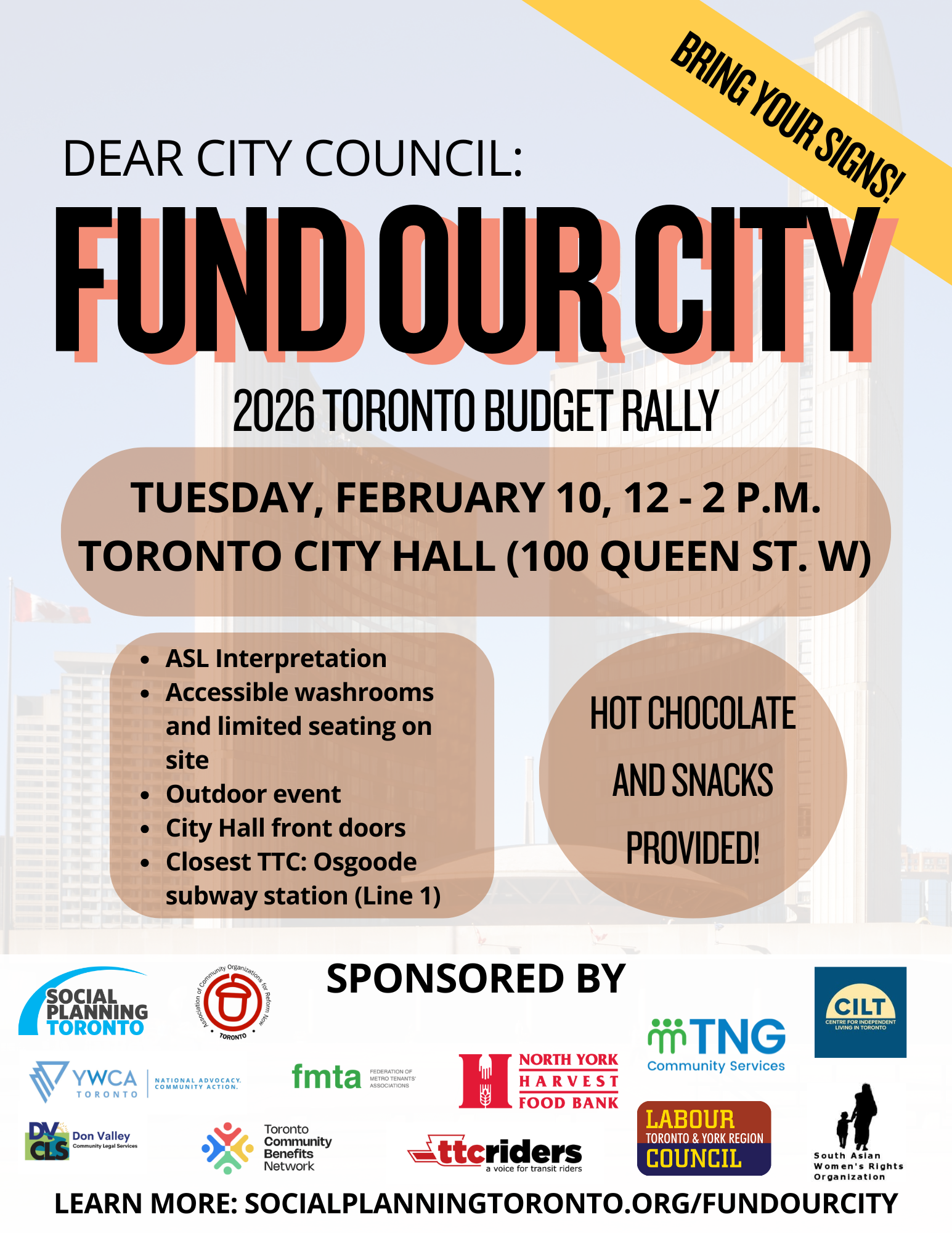
The budget isn’t final yet. On February 10, Toronto City Council will meet for its final budget votes. Councillors will have an opportunity to move motions to amend the Mayor’s Budget and decide how to use $2 million in unallocated funds.
- Join Social Planning Toronto and community partners at the Fund Our City rally at Toronto City Hall (100 Queen Street West) on Tuesday, February 10 at noon! RSVP here.
- Tell Your City Councillor to invest in reliable, safe, and affordable transit in the 2026 City Budget using TTCriders’ fast and easy form.
- Take part in Progress Toronto’s City Budget Watch Party. You can join throughout the day on Tuesday, February 10 at City Hall or on Zoom to watch Council debate and vote on the 2026 City Budget.