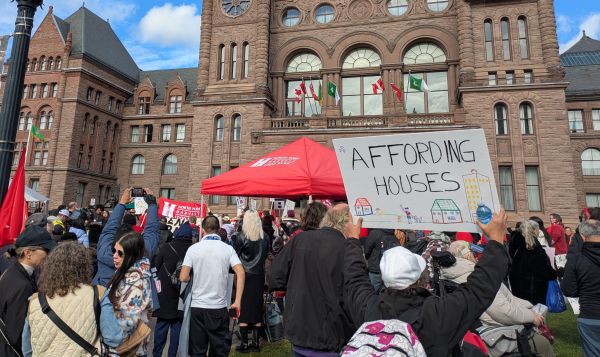
On October 23, the provincial government introduced Bill 60, also called the “Fighting Delays, Building Faster Act.” The omnibus Bill contains a number of troubling proposals that would see (even more) provincial overreach of municipal issues and a further weakening of tenant rights. Immediately, tenant activists and organizations sprung into action. ACORN Canada organized an e-mail campaign that saw 23,000 tenants contact their reps in just four days
The Province is expected to push Bill 60 through on November 17. ACORN Canada’s e-mail template is still live, and concerned residents can use it to contact their MPPs.
This week, Toronto City Council adopted a motion to formally oppose the changes to the Residential Tenancies Act in Bill 60, and to request the Province expand tenant protections and invest more in affordable housing. SPT submitted a letter in favour of the motion, which you can read on our website.
In this issue:
- Our Latest Op-Ed Responds to Misinformation and Stigma Around Homelessness
- Two Events on Shelter Advocacy (November 17 and 20)
- SPT is a Living Wage Network
- Ontario Nonprofit Network’s Sector-Wide Survey Shows Demand for Programs and Services are Outpacing Capacity
- Two-Part Report Tracks Evolution of Community Land Trusts in Toronto
- Daily Bread’s 2025 Who’s Hungry Report Reveals One in Four Toronto Children Rely on Food Banks
- Province to Shut Down Parkdale Supervised Consumption Site
- Imagining a Future Without Poverty
- Survey: Provide Feedback for Ontario’s Poverty Reduction Strategy
- Province Releases Fall Economic Statement
- Applications Open for 2026 Local Leadership Grant
- Two New Reports Shed Light on State of Labour in Ontario
Our Latest Op-Ed Responds to Misinformation and Stigma Around Homelessness
Last month, Social Planning Toronto and YWCA Toronto co-authored an op-ed in the Toronto Star with the headline, "Here’s what ‘thinking of the children’ would really look like when it comes to homelessness in Toronto." The piece highlights the number of children in Toronto experiencing homelessness, and the need to support solutions including permanent shelters.
Read the full article on the Toronto Star's website, or access the free version via the Toronto Public Library.
See all of SPT's media coverage, including earned media mentions and pieces that we have authored.
Two Events on Shelter Advocacy (November 17 and 20)
On November 17, from 7 - 9 p.m., Social Planning Toronto will host Working Together for Shelter Advocacy, a workshop designed to provide interested individuals, community leaders, and local groups with tools and tips to engage in open, informed, and productive conversations about homelessness.
On November 20, from 10 a.m. - 12 p.m., join us for Framing Dialogue and Advocacy Around Shelters. This workshop will provide service providers practical strategies and tools to strengthen dialogue, challenge misconceptions, and promote messaging that builds understanding and support for housing and shelter solutions.
Both events are free and open to the public.
For more on this topic, see Talking About Homelessness, a messaging guide for organizations, communities, and individuals developed by SPT in partnership with community activist Diana Chan McNally.
SPT is a Living Wage Network
Social Planning Toronto is proud to announce that we have been certified as a living wage employer by the Ontario Living Wage Network. At SPT, we believe that dignity, equity, and justice must begin at home. Our work is rooted in the belief that everyone deserves the opportunity to live and thrive with security, and that starts with fair compensation and decent work. Learn more about how to become a living wage employer.
Ontario Nonprofit Network’s Sector-Wide Survey Shows Demand for Programs and Services are Outpacing Capacity
Ontario Nonprofit Network has released the findings from their annual sector-wide survey. One megatrend revealed by the data is that non-profit organizations were largely affected by the economic downturn, which has been hindering almost all aspects of operations. The demand for nonprofit programs and services continues to increase while the capacity to meet the demands remains stagnant, and the overall number of nonprofits programs and services are decreasing. See the full survey results.
Two-Part Report Tracks Evolution of Community Land Trusts in Toronto
The Metcalf Foundation released a two-part report on Community Land Trusts (CLT), based on author Kuni Kamizaki’s decade of involvement with the Parkdale Neighbourhood Land Trust (PNLT). Part one, From the Ground Up: History of the Parkdale Neighbourhood Land Trust traces the roots of PNLT’s organizing, strategic planning, and policy advocacy. Part two, Grounding Transformation: Possibilities for Community Land Trusts explores the transformative potential of CLTs
Over the past year, SPT has been supporting community wealth building initiatives as a pathway for neighbourhoods to take collective ownership and democratic control over parts or our local economies (including housing and jobs) in an effort to achieve economic, racial, and climate justice.
CLTs take land off the speculative market and place it under community control to protect permanent affordability. This new report offers critical reflections for practitioners to ensure their work does not replicate the harms of our current economic system and stays rooted in community values.
Daily Bread’s 2025 Who’s Hungry Report Reveals One in Four Toronto Children Rely on Food Banks
Daily Bread Food Bank and North York Harvest Food Bank have released Who’s Hungry 2025, their annual report which provides a profile of food insecurity and poverty rates within Toronto. The report reveals that Toronto residents are becoming reliant on food banks more frequently and for longer periods of time, as one in 10 Torontonians and one in four children are relying on food banks. The report also shows that education and employment is becoming less of a safeguard against food insecurity, as 35% of survey respondents work multiple jobs, and 57% have a post-secondary degree or higher. Read the full report.
Province to Shut Down Parkdale Supervised Consumption Site
Last month, the provincial government announced that they would be defunding one of the City’s last remaining supervised consumption sites (SCS), forcing its closure. The site, run by Parkdale Queen West Community Health Centre, joins several other Toronto SCS forced to close down by the Province earlier this year, despite the fact that Ontario is in the midst of an opioid poisoning epidemic. Between 2016 and 2023, 26,673 Ontarians died from an opioid or stimulant overdose.
The evidence has repeatedly shown that SCS save lives, reduce crime, and make all of us safer.
Progress Toronto has created a letter template to contact Premier Doug Ford and Health Minister Sylvia Jones in support of supervised consumption sites.
Imagining a Future Without Poverty
To mark the International Day for the Eradication of Poverty on October 17, Campaign 2000 hosted a virtual dialogue featuring a powerful lineup of leaders, advocates, and changemakers advancing equity and poverty eradication across Canada (including SPT staff members Stacia Stewart, Shannon Spencer, and Mercedes Sharpe-Zayas). A recording of the event is available.
Survey: Provide Feedback for Ontario’s Poverty Reduction Strategy
The Province of Ontario is currently soliciting public feedback in shaping the next poverty reduction strategy. They are asking Ontarians to share their experiences, perspectives and ideas to reduce poverty, and that includes feedback. Feedback can be provided via survey or written submission until November 30. Learn more.
Province Releases Fall Economic Statement
Ontario's Fall Economic Statement is a mid-year budget update that outlines the provincial government's economic outlook, adjustments to the budget, and new policy initiatives. Released on November 6, the statement provides insight into the provincial government's priorities, such as housing, health care, and changes to taxes which directly affect residents and local businesses.
This year, investment priorities include tax relief for first time buyers and commitments to infrastructure development. However, the statement does not include direct support for renters and low-income residents, nor does it introduce any new funding specifically for affordable housing. Read the full statement.
Applications Open for 2026 Local Leadership Grant
The City of Toronto’s Local Leadership Grant aims to support resident-led events and activities Toronto Strong Neighbourhoods Strategy. A funding amount of $5000 is available per group. Applications are open until Monday, November 24, 2025. Learn more and apply.
New Report Sheds Light on State of Labour in Ontario
Last month, Workers’ Action Centre (WAC) released The Crisis of Wage Theft in Ontario. The report found that in the last 10 years, almost $200 million dollars has been assessed as owing to workers in Ontario, and 60% of surveyed workers have experienced wage theft.
Along with the report, WAC has launched a campaign urging the provincial government to enforce the Employment Standards Act, close gaps in the law that allow wage theft to happen, and to empower workers to enforce their rights while on the job. The campaign includes an e-mail template you can use to contact your MPP and the Ministry of Labour.