
The following newsletter was distributed to our subscribers on June 26, 2025. Sign up for our newsletter here.

Right before closing the legislature for the summer holiday, both the provincial and federal governments passed through a wave of legislation that will have serious implications for environmental protections, Indigenous rights, labour protections, housing justice, and more. It can be difficult to keep track of how these new laws will impact our communities, so we’ve highlighted some of the most consequential ones below, along with a few ways you can take action. Though our work at SPT usually concerns what happens at the municipal level, these bills, especially when examined collectively, threaten to override our local democracy by giving decision makers at the provincial and federal levels the power to bypass local regulations designed to support some of our most marginalized populations.
But first, we would like to take this opportunity to share our 2024/2025 Annual Report. As we continue to face a series of obstacles in the fight to make Toronto a more equitable city, we believe it’s important to check in on our progress and celebrate recent accomplishments. The Annual Report highlights what we’ve been up to in the last year, including the launch of the 2024 Child and Family Poverty Report Card, our work and collective impact around the 2025 City Budget that led to key investments in social services, our presence in the Toronto Star advocating for the issues that matter to Torontonians, and so much more.
In this issue:
- Record Heat Leaves Unhoused, Tenants Vulnerable
- Did You Know? Telephone Application Supports Offered for Low-Income Residents
- "Bubble Zone" Bylaws Receive Further Pushback
- Ontario Bills 5 and 17 Aim to Fast Track Development at the Expense of Labour and Environmental Protections
- Two Ontario Bills Claim to Make Municipalities Safer by Criminalizing Poverty
- Yet-to-be-Passed Bill Threatens Provincial Overreach in Nonprofit Organizational Matters
- Federal Government Tables Border Security Bill That Would Limit Refugee Claims, Enable Mass Surveillance
- Bill C-5 Receives Criticism from Environmental Groups, Indigenous Leaders
- SPT Signs Onto Open Letter Urging Province to Reverse Decision Restricting HART Hubs from Distributing Harm Reduction Supplies
- Making Connections, Fostering Collaboration
Record Heat Leaves Unhoused, Tenants Vulnerable
Earlier this week, Toronto experienced an extreme heat wave, with the humidex increasing to 45°C. This temperature is dangerous for all people, but small children, seniors, people with disabilities, and pregnant and unhoused people are especially vulnerable.
Advocacy group Shelter Housing and Justice Network criticized the City’s inadequate heat relief strategy and are calling for the City to immediately bring back 24/7 cooling centres, which were closed in 2019. A coalition of organizations including ACORN, the Advocacy Centre for Tenants Ontario, and the Toronto Environmental Alliance has called on the City of Toronto to take action to protect tenants from extreme heat. These actions include establishing a by-law to ensure a maximum temperature in residential rental buildings, provide funding to make capital expenditures to upgrade buildings to be energy efficient, and implement emergency measures during extreme heat events. ACORN Canada has also created a template that you can use to e-mail the Federal and Provincial Housing and Environment ministers demanding increased tenant protections against renovictions while buildings undergo energy efficient retrofits.
Did You Know? Telephone Application Supports Offered for Low-income Residents
The City of Toronto’s Human Services Integration Office (HSIO) is a contact centre that provides residents with telephone application support for a variety of low-income social programs (including rent-geared-to-income housing programs, emergency assistance, medical benefits hardship funds, funeral and burial services, child care fee subsidies, and the Fair Pass Transit Discount program). HSI can be reached at 416-338-8888. Learn more at their website.
“Bubble Zone” Bylaws Receive Further Pushback
Social Planning Toronto was one of several organizations interviewed in a new article by Future of Good on how a Toronto bylaw aimed at restricting protests near so-called “vulnerable social infrastructure” will hinder the types of demonstrations that have historically driven badly needed social change. (The piece is paywalled, but we believe Future of Good’s consistent reporting on key social issues more than warrants a subscription.) SPT’s Executive Director Jin Huh is quoted as saying “The benefits of all the protests that have happened over centuries are what enable us to have the progressive policies that we have today.”
On Tuesday, the Canadian Civil Liberties Association launched Charter litigation against Vaughan’s bubble zone bylaw. (Vaughan’s bylaw is significantly more restrictive than Toronto’s, and makes people liable for fines up to $100,000.) In explaining why they launched a charter challenge, CCLA claims that if left unchecked, anti-protest bylaws like Vaughan’s will mark the beginning of a slippery slope that will erode people’s constitutionally protected right to use civic space to voice their thoughts, opinions and beliefs.
To learn more about your right to protest in Toronto under this bylaw, check out our explainer on our blog. A recent episode of CBC’s Front Burner provides more context around the bylaws, in Toronto and across Canada.
Ontario Bills 5 and 17 Aim to Fast Track Development at the Expense of Labour and Environmental Protections
On June 5, the Ontario Government passed Bill 5, Protect Ontario by Unleashing Our Economy Act, 2025. The bill claims to “cut red tape” to “unleash the economy” by hampering the ability of municipalities to enforce local green building standards and undermining decades of work on climate resilience. The bill also empowers the cabinet to create “special economic zones” that will bypass the duty for companies to consult Indigenous communities and comply with worker protections, opening the door to unsafe labour conditions and a backsliding of progress towards Indigenous self-determination.
Indigenous leaders and civil and environmental groups including Toronto Environmental Alliance, Canadian Civil Liberties Association, the Ontario Federation of Labour, CUPE Ontario, and the Toronto and York Region Labour Council, have raised serious concerns about how the bill undermines Indigenous rights, environmental standards and climate action, public health, and local democracy by concentrating decision-making powers.
Learn more about public actions and campaigns working to repeal Bill 5.
On the same day that they passed Bill 5, the Legislative Assembly of Ontario also passed Bill 17, Protect Ontario by Building Faster and Smarter Act, 2025. Bill 17 aims to fast track housing, road, and transit construction by streamlining the development process and removing municipal green building standards. Toronto Environmental Alliance has warned that bypassing the Toronto Green Standard, including energy efficiency requirements and limits on hard surfaces to minimize stormwater runoff, will give “developers permission to pay less now so that residents pay more later.”
Read Toronto Environmental Alliance’s full statement in response to Bill 17.
Two Ontario Bills Claim to Make Municipalities Safer by Criminalizing Poverty
Bill 6, Safer Municipalities Act, 2025, gives police officers the power to, under their own discretion and without a warrant, remove individuals from their encampment dwelling on suspicion that they have consumed an illegal substance, as well as arrest those individuals who do not comply with police orders to leave their encampment dwelling. It also allows police to levy fines of up to $10,000, and/or incarceration of up to six months.
This bill will effectively criminalize unhoused people and substance users who have already lost access to safe places to use following the province’s closure of supervised consumption sites. As the Canadian Civil Liberties Association has pointed out, over 26,000 Ontarians have lost their lives since 2016 in the ongoing overdose crisis. Further condemnations of this bill have been made by dozens of other organizations, including the Advocacy Centre for Tenants Ontario (ACTO), the Canadian Alliance to End Homelessness, and the Canadian Centre for Housing Rights.
Similar concerns, too, have been expressed over Bill 10, Protect Ontario Through Safer Streets and Stronger Communities Act 2025. This bill holds landlords liable if they knowingly permit drug-related activity. ACTO has criticized the bill for its vague language and for opening the door to evictions based on suspicion rather than evidence. CCHR raised concerns over how the bill undermines renters’ rights to privacy and security, and puts undue burdens on housing providers, especially non-profit and supportive housing providers.
Yet-To-Be-Passed Bill Threatens Provincial Overreach in Nonprofit Organizational Matters
Bill 25, Emergency Management Modernization Act, 2025 authorizes the Minister of Children, Community, and Social Services to issue any directives to organizations receiving funding for community and social service provision in extraordinary circumstances; if the funded organization is non-compliant, the Minister can clawback funding or fine every director of the organization. The Ontario Nonprofit Network (ONN) is monitoring the bill and working with their networks to understand its implications. Stay up-to-date by subscribing to ONN’s newsletter.
Federal Government Tables Border Security Bill That Would Limit Refugee Claims, Enable Mass Surveillance
Bill C-2, introduced earlier this month in the House of Commons, is an omnibus bill will block anyone who has been in Canada for more than one year from claiming refugee status, expand Canada Post’s authority to open people’s letters and allow the government to share personal information with US authorities, grant the Immigration Minister authority to cancel permits for entire groups en masse, and boost the powers of border agents and law enforcement. Advocates warn that this bill restricts protections for migrants and refugees, and that all Canadian residents will be affected by increased mass surveillance. Statements have been released by The Ontario Council of Agencies Serving Immigrants and a series of other coalitions representing over 3000 organizations demanding complete withdrawal of Bill C-2.
The Migrant Rights Network has put together a series of actions you can take, including an e-mail template you can use to urge your MP to withdraw Bill C-2, downloadable and printable flyers, and shareable social media graphics.
Bill C-5 Receives Criticism from Environmental Groups, Indigenous Leaders
Last week, the House of Commons approved Bill C-5, An Act to enact the Free Trade and Labour Mobility in Canada Act and the Building Canada Act. Similar to Ontario’s Bill 5, this bill would give the federal cabinet the ability to fast-track major industrial projects, such as mines, pipelines, and ports, potentially sidestepping assessment requirements. Environmental and Indigenous groups including the Canadian Environmental Law Association, the Assembly of First Nations, and the Climate Action Network warned the bill could pose risks to environment, health, and Indigenous rights; further criticisms were made about how the legislation was rushed through Parliament without any consultation with Indigenous peoples. CUPE National has created a letter writing template that you can use to contact your MP urging them to rethink Bill C-5, criticizing the bill for putting corporate interests ahead of workers, public services, and Indigenous rights.
SPT Signs Onto Open Letter Urging Province to Reverse Decision Restricting HART Hubs from Distributing Harm Reduction Supplies
HIV infections in Canada are on the rise. In 2022, 9.3% of Ontario’s 475 new HIV infections were among people who inject drugs. Ample research has confirmed that sterile drug using equipment, needle exchange programs, and consumption and treatment services prevent the spread of HIV. Yet earlier this year, new legislation from the Province forced the closure of nine supervised consumption sites (which distribute harm reduction supplies, including sterile equipment), with plans to replace them with Homeless and Addiction Recovery Treatment (HART) Hubs. These hubs are prohibited from distributing sterile needles and equipment.
SPT signed onto a joint letter spearheaded by HIV Legal Network calling on the Province to listen to decades of evidence and reverse the disastrous policy decision restricting HART Hubs from sterile needle and syringe distribution. Read the full letter and add your endorsement (open to organizations, researchers, and health care providers).
Making Connections, Fostering Collaboration
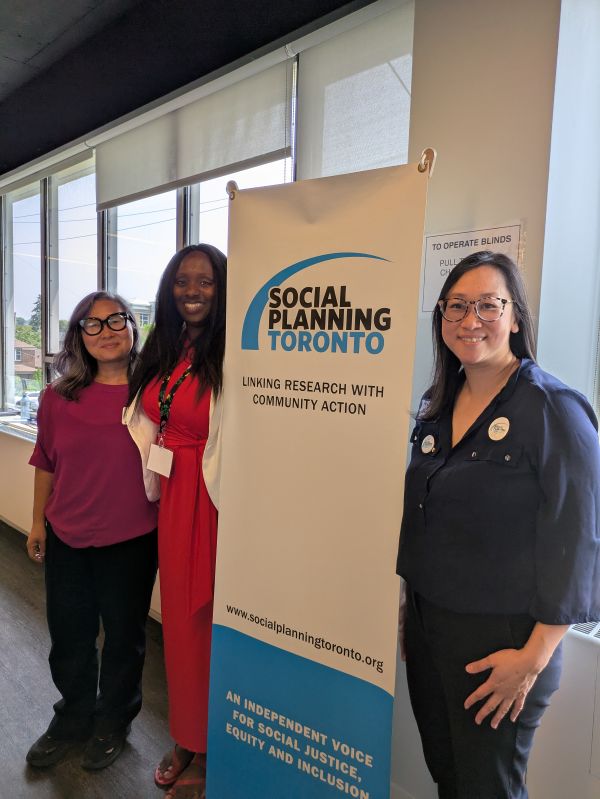
On June 11, Social Planning Toronto, in partnership with Toronto Neighbourhood Centres, hosted a Meet and Greet with senior staff from the City’s Social Development Division and over 25 senior leaders from frontline service providers across Toronto. The event included opening remarks from Deputy City Manager, Denise Andrea Campbell, who has worked closely with community-based organizations in her previous role as Executive Director of the Social Development Division. Mohamed Shuriye, Interim Executive Director of the Social Development Division discussed the importance of ongoing collaboration between the community sector and the City of Toronto to strengthen the wellbeing of our diverse communities. The event was hosted at the Keele Community Hub, a multi-service hub in a former Toronto Hydro building. As leadership has turned over at both the City of Toronto and in the community sector, this meeting provided an opportunity to build new connections and collaborations with new and old partners. The event was over-subscribed and there was a strong interest in turning this into a semi-annual meeting!