2025-2026
How do we measure the impact of an organization?
There are the quantifiable indicators that fill out quarterly reports and grant applications: research published, workshops delivered, media mentions, newsletter subscribers, social media metrics, and attendance numbers. These measures matter. They help us understand the reach of our work and the ways people connect with it.
But they only tell part of the story.
At Social Planning Toronto, impact also shows up in the strength of the coalitions we help convene, the community voices that are brought into public decision-making, the research that gives people language and evidence for what they are already experiencing, and the policy progress that becomes possible when organizations and residents act together.
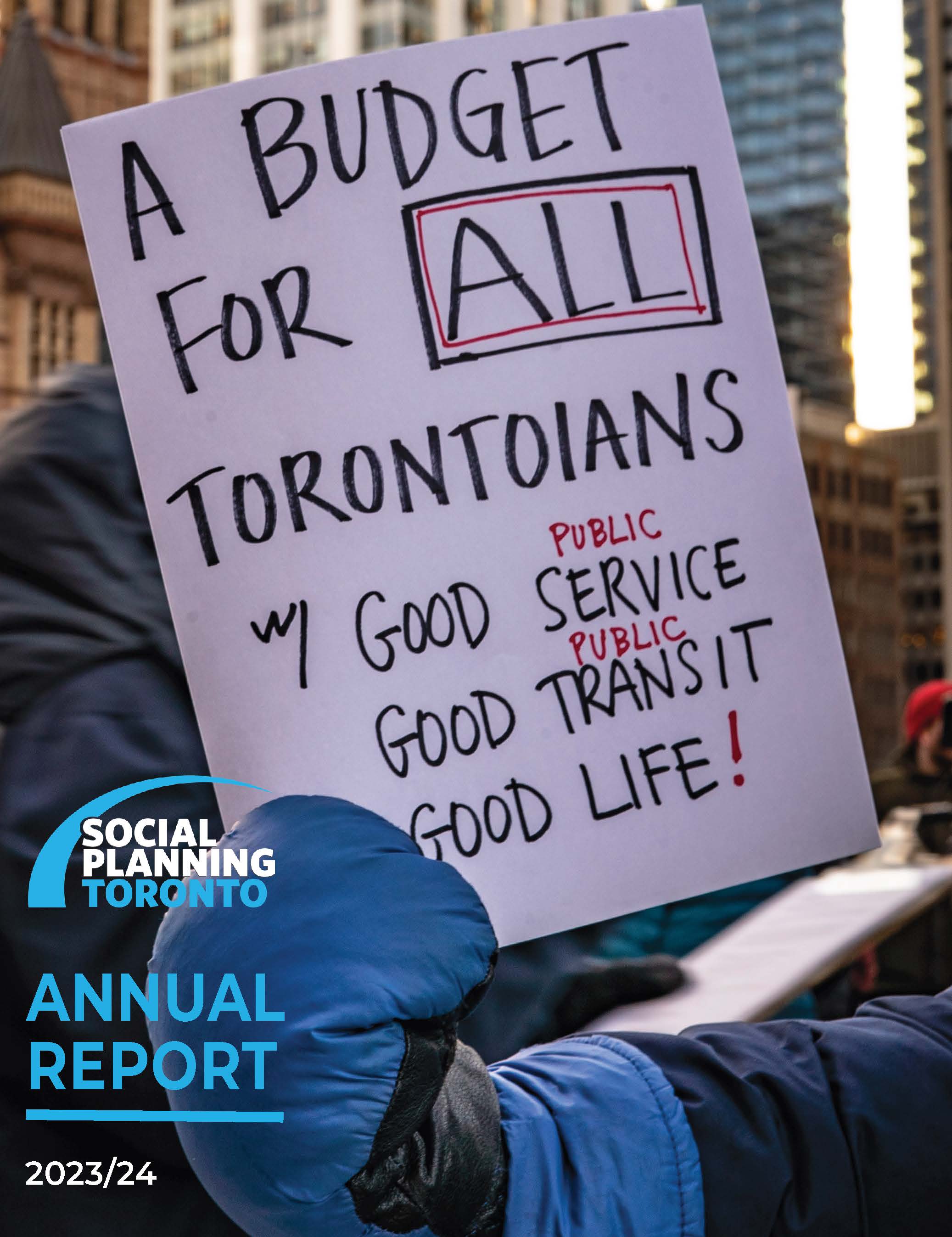
This year, SPT once again led the City Budget Coalition in partnership with more than 150 organizations. Through months of organizing, analysis, engagement, and advocacy, the coalition helped advance a community-centred vision for the City Budget. Ahead of Council’s final budget meeting, 78 community and faith-based organizations and 193 workers co-signed a letter urging investments in affordable housing, transit, youth employment, poverty reduction, and more. On February 10, approximately 250 residents and community partners gathered outside City Hall for the Fund Our City Rally.
By our calculation, the final 2026 City Budget included $30.445 million in new and enhanced programs and services. These investments included the introduction of TTC fare capping, additional funding for the Rent Bank and RentSafeTO, an expansion of the Student Nutrition Program, expanded Toronto Public Library hours, and support for a Toronto Community Crisis Service TTC pilot program. We share this victory with our broader communities and with those on City Council who support a more equitable Toronto.
Other outcomes are more personal, but no less significant.
We heard from organizers who used our Talking About Homelessness guide to support more informed, constructive conversations in their own communities. We heard from personal support workers who attended the launch of Caring About Care Workers. They shared their experiences of a healthcare system that significantly undervalues their critical work and too often ignores their voices. We saw young people who participated in deputation training gain the tools to speak directly to decision-makers about the need for accessible community spaces in Weston.
These moments are harder to capture in a single metric. Yet they reflect something central to SPT’s role: helping residents, grassroots groups, frontline organizations, researchers, advocates, and policymakers connect lived experience with public policy.
Our research continued to shape public understanding. This year, SPT published three major reports, each addressing a different dimension of inequity in Toronto: the working conditions of immigrant women personal support workers in our home care sector; the potential of community wealth building as a model for democratic economic development; and the deepening reality of child poverty, which affects one in four children in the city. Through these reports, blog posts, op-eds, submissions, and policy analysis, we make complex social and economic issues more visible, accessible, and actionable to the general public.
Organizational impact often extends beyond what we can track. The work ripples out when people read reports months after publication, share resources through their networks, or are influenced when developing policy positions. Media outlets cite our work in stories about poverty, homelessness, care work, democratic rights, and the City Budget. Residents attend a workshop, watch a recording, read a blog post, or stop by a rally, and leave with a clearer sense of how decisions are made and how they can participate. These outcomes are not necessarily quantifiable, but they work together to shift public knowledge, narrative, and solutions to systemic poverty and inequality.
In this annual report, we have highlighted some of the ways SPT’s work has contributed to policy progress, community capacity, sector collaboration, and public dialogue over the past year. Systems change is long-term work. It is often cumulative, collective, and difficult to separate from the efforts of the many partners, communities, and movements we work alongside.
We remain deeply grateful to all our funders, sustaining partners, donors, and organizational members, particularly United Way Greater Toronto and the City of Toronto. We also thank the Metcalf Foundation and the Atkinson Foundation for their project-based support.
To everyone who has worked with us, shared expertise, attended a meeting, joined a coalition, read a report, made a deputation, supported our advocacy, or helped us imagine a more equitable Toronto: thank you.
We are in it for the long haul.
Correction: On page 13, the name of our Civic Leader Gabe Ermatinger is misspelled as Ermitinger. SPT regrets the error.